AI Receptionist for Property Management: What It Does and Why It Works

Anyone who manages a residential or commercial property portfolio knows the same problem repeats across every building: the phone rings while staff are on-site handling a different issue, a maintenance request comes in at 9 PM and sits unaddressed until morning, or a prospective tenant calls about a vacancy and gets voicemail instead of an answer.
Every one of those moments is a small revenue or retention leak. A missed leasing call is a unit that stays vacant longer. An unanswered maintenance request at night is a frustrated tenant who may not renew. A property management team that cannot staff phones around the clock is not failing at their job – they are running into a structural limit that AI receptionists are specifically built to solve.
This article covers how an AI receptionist for property management works, what it actually handles, and what separates a good implementation from a generic chatbot bolted onto a phone line.
What Property Management Calls Actually Look Like
A typical property management office fields a recurring mix of call types: prospective tenants asking about vacancies, pricing, and showing availability; current tenants reporting maintenance issues, ranging from urgent (no heat, water leak) to routine (squeaky door); rent payment questions and lease renewal inquiries; package and delivery notifications; and vendor or contractor coordination calls.
Most of these calls follow predictable patterns. A leasing inquiry needs the same five or six pieces of information regardless of which prospect is calling. A maintenance request needs to be logged, categorized by urgency, and routed to the right vendor or technician. This is exactly the kind of structured-but-conversational task that AI handles well, and it is also exactly the kind of task that burns through staff time when handled manually, one call at a time.
The volume problem compounds with portfolio size. A property manager overseeing 200 units across multiple buildings cannot realistically staff a phone line 24 hours a day without either overstaffing for off-peak hours or accepting that a meaningful share of calls go unanswered.
What an AI Receptionist Handles
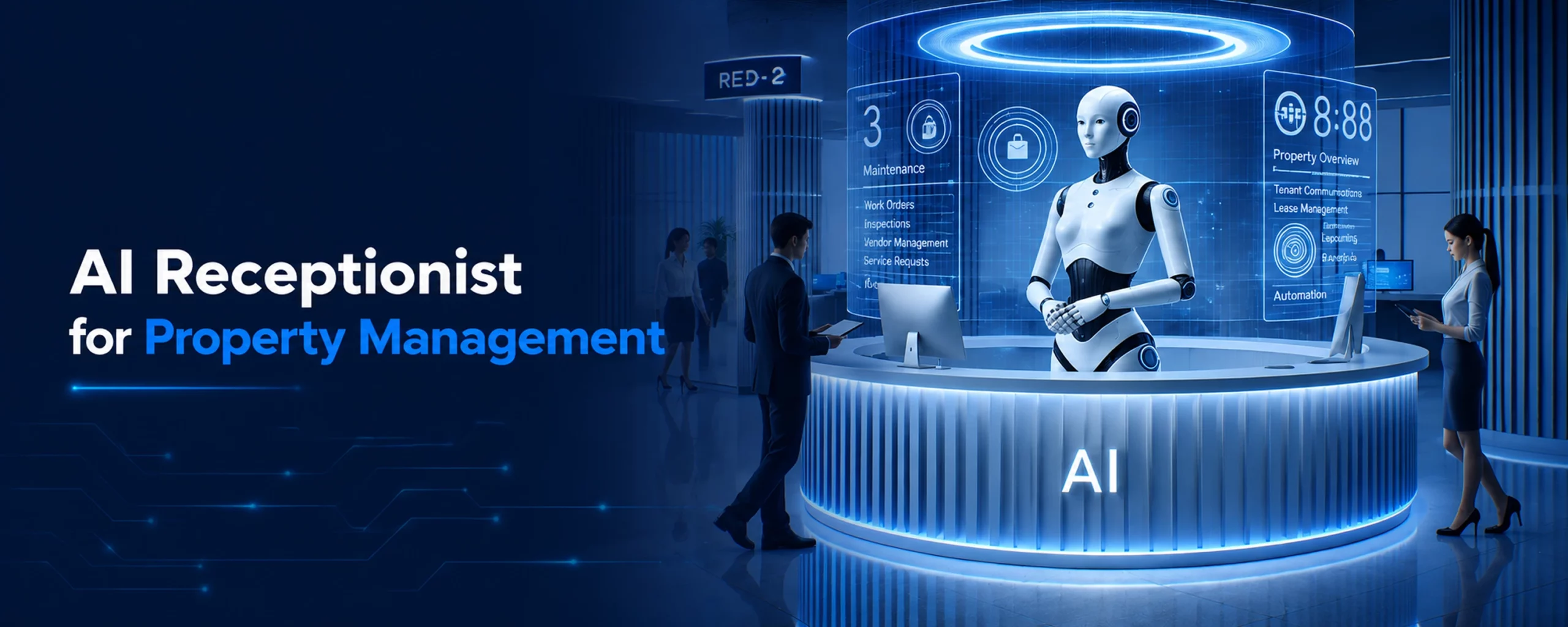
An AI receptionist for property management is a conversational AI agent – operating over phone, SMS, or web chat – that answers every inbound contact instantly and handles it through to resolution or proper routing, without requiring a human on the call.
Leasing inquiries. When a prospective tenant calls about a vacancy, the AI answers immediately, provides pricing and availability information, qualifies the prospect (move-in timeline, household size, pet policy fit, budget), and books a showing directly into the leasing calendar. No voicemail, no callback delay, and no lost prospect to a competing listing that answered faster.
Maintenance request intake and triage. Tenants reporting an issue get a structured conversation rather than a voicemail box. The AI captures the unit number, issue description, and urgency level, distinguishes emergency issues (no heat, active leak, safety concern) from routine ones, and automatically creates a ticket or work order in the property management system. Emergency issues can be configured to immediately alert on-call staff, while routine requests queue normally.
Rent and account questions. Common questions – rent due dates, payment portal access, late fee policy, lease renewal status – are answered directly without requiring a callback from office staff, freeing that time for issues that genuinely need a human.
Appointment scheduling. Showings, maintenance visits, and move-in/move-out inspections get scheduled directly through the AI conversation, synced to the relevant calendar, with confirmation sent automatically.
After-hours and overflow coverage. This is where the gap is most pronounced for most property management operations. An AI receptionist provides the same response quality at 11 PM on a Sunday as it does at 11 AM on a Tuesday – which matters enormously for tenant satisfaction and for capturing leasing inquiries that come in outside business hours.
Escalation to human staff. A well-built AI receptionist knows its limits. Complex disputes, lease negotiation, or anything requiring judgment gets routed to the right person with full conversation context, rather than the AI attempting to resolve something it should not.
Why Response Speed Matters More Than Most Property Managers Realize
Two distinct revenue and retention mechanisms are at play here, and they are worth separating out.
On the leasing side, prospective tenants calling about a vacancy are often calling multiple listings in the same session. The first property that answers the phone, gives a clear answer, and books a showing has a structural advantage over the next one that sends the call to voicemail. Every missed leasing call is a real chance the prospect signs with a competing property before your team calls back.
On the maintenance side, the mechanism is different but just as real. Tenants who report an issue and get immediate acknowledgment – even if the actual repair happens the next business day – report meaningfully higher satisfaction than tenants who leave a voicemail and hear nothing back for hours. The acknowledgment itself, done well, reduces frustration independent of resolution speed. An AI receptionist that confirms the issue was logged, gives a realistic timeline, and flags true emergencies for immediate attention closes most of that satisfaction gap without requiring a human to be available at the moment the tenant calls.
Multifamily vs. Single-Family Portfolio Considerations
The case for an AI receptionist holds across portfolio types, but the economics and configuration differ.
Multifamily and large portfolio operators typically see the strongest ROI from call volume alone. A 300-unit building generates enough leasing and maintenance calls that even modest staff time savings translate into meaningful cost reduction, and the after-hours coverage gap is usually most acute here, since on-site staff cannot be present around the clock.
Single-family and smaller portfolio operators see a different but equally real benefit – consistency and professionalism. A property manager handling 30 – 50 scattered single-family rentals often cannot justify dedicated front-desk staff at all, which means every call currently goes to a property manager’s personal phone, interrupting other work. An AI receptionist gives smaller operators front-desk-level responsiveness without the staffing cost that would normally require.
In both cases, the qualification logic and routing rules need to reflect the specific portfolio – a 300-unit building has different maintenance escalation needs than a portfolio of single-family homes spread across a metro area, and the AI configuration should reflect that rather than applying a generic template.
What to Look for in an AI Receptionist Solution
Not all AI phone and chat tools are built with property management’s specific operational needs in mind. The following matter most when evaluating a solution.
Natural conversation handling. Property management calls are rarely scripted on the caller’s side. A tenant describing a maintenance issue does not phrase things in predictable ways. The AI needs to handle genuine conversation and follow-up questions, not just match against a rigid keyword tree.
Property management software integration. An AI receptionist only creates real operational value if it writes directly into the systems your team already uses – work orders into your maintenance system, showings into your leasing calendar, tickets into your PM software. A disconnected point solution creates double entry rather than eliminating it.
Configurable urgency and escalation logic. Emergency maintenance issues need to trigger immediate human alerts. The escalation rules need to be configurable to your specific definitions of urgent versus routine, and adjustable as your team learns what actually needs immediate attention.
Multi-channel coverage. Tenants and prospects reach out by phone, text, and increasingly chat. A receptionist solution that only covers one channel leaves real gaps in coverage.
Voice quality. For phone-based interactions specifically, natural-sounding, human-like voice AI matters significantly. Older-generation IVR-style phone trees with robotic voice prompts create exactly the frustrating experience an AI receptionist is meant to eliminate.
Deployment speed and ownership model. A property management operation evaluating AI receptionist technology wants to see results quickly, not commit to a long implementation cycle before any value materializes.
Whether the solution is offered as a managed service or as a fully owned system – with source code and infrastructure control – is also worth evaluating against your long-term cost and compliance needs.
How Isometrik AI Approaches AI Receptionist Deployment
Isometrik AI builds production-ready conversational AI infrastructure designed to deploy in weeks, not months – which directly addresses the deployment speed concern most property management operators have when evaluating AI tools for the first time.
Voice AI infrastructure handles natural, human-like phone conversations for both inbound tenant and prospect calls and outbound follow-up, which matters significantly for property management given how much of this volume is still phone-first.
Conversational AI extends the same capability across SMS and chat, so tenants and prospects can reach out through whichever channel they prefer and get a consistent, accurate response.
Agent Studio allows property management teams to configure the qualification logic, escalation rules, and routing without requiring an in-house engineering team – meaning urgency definitions and workflow logic can be set up to match how your specific operation actually works, rather than a generic template.
CRM integration built into the platform syncs conversation data, maintenance tickets, and leasing activity directly into the systems your team already uses, so nothing requires manual re-entry.
Conclusion
An AI receptionist for property management solves a problem that has quietly cost operators leasing revenue and tenant satisfaction for years: the structural impossibility of staffing phones around the clock at the volume and speed tenants and prospects now expect.
By handling leasing inquiries, maintenance triage, rent questions, and appointment scheduling instantly and consistently – then escalating to human staff exactly when it should – AI receptionists close a coverage gap that no amount of additional headcount fully solves.
The technology has matured enough in 2026 that deployment now takes weeks, not months, and ownership models exist that give property management operators real control over their AI infrastructure rather than locking them into an open-ended subscription.
If your team is evaluating AI receptionist technology, explore Isometrik AI’s pre-built AI agents and book a free strategy call to see what a deployment timeline looks like for your portfolio.