How Much Does AI Voice Agent Cost? A 2026 Pricing Breakdown

How much does AI voice agent cost? It sounds like a simple question. Then you pull up a pricing page and see “$0.05 per minute” — and think you’ve got your answer. Not really.
That number is the orchestration layer. It doesn’t include the speech-to-text engine, the LLM processing your calls, the text-to-speech voice your customers actually hear, or the telephony carrier routing those calls. Stack all four together and the real all-in cost lands between $0.12 and $0.45 per conversation minute depending on platform, voice quality, and usage volume.
This blog cuts through the fluff. You’ll get the real per-minute math, a breakdown of every pricing model in the market, a platform comparison table, and an honest look at how AI voice agent costs stack up against what you’re currently paying human agents.
What’s Actually Driving AI Voice Agent Costs in 2026
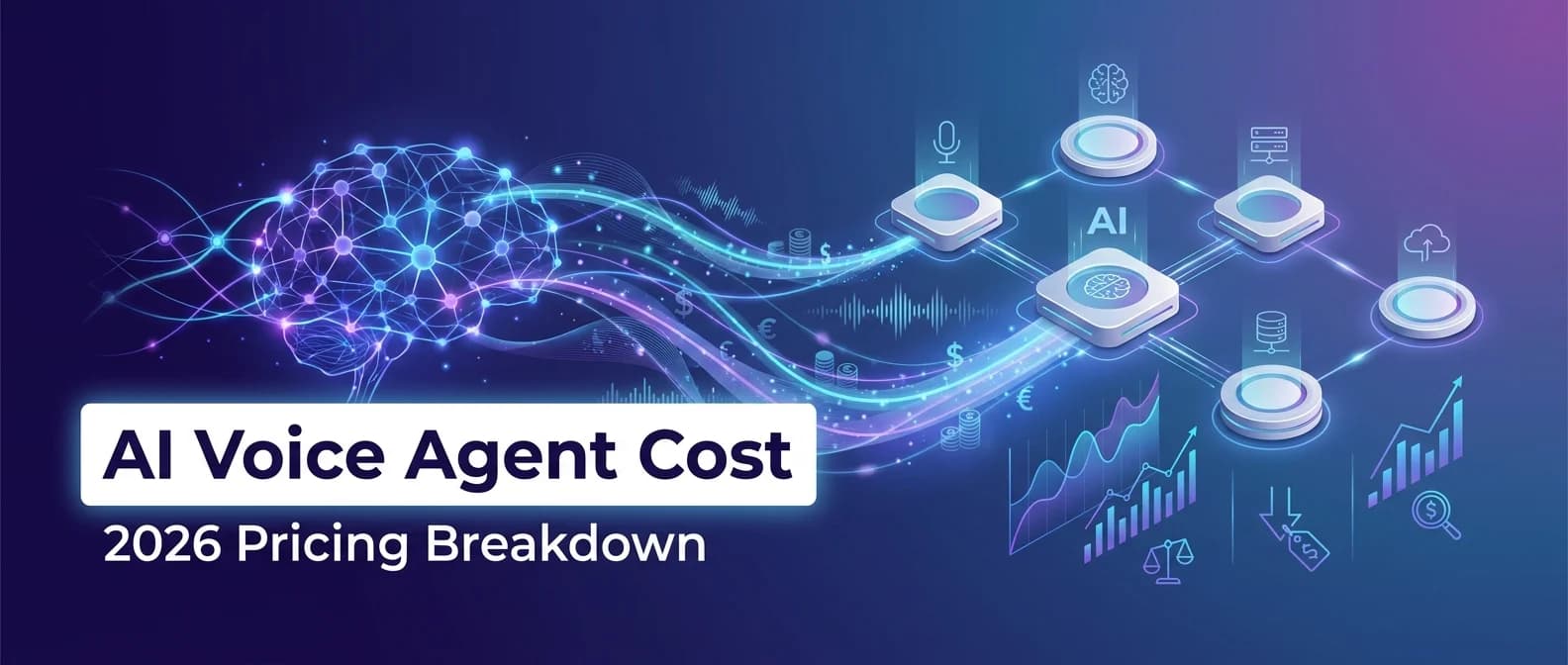
Before you compare any two platforms, you need to understand what you’re actually paying for. Every AI voice agent is a four-part stack, and each component carries its own price tag.
- Speech-to-Text (STT): Converts the caller’s voice into text the AI can process. Common providers like Deepgram charge approximately $0.008–$0.012 per minute.
- Large Language Model (LLM): The AI brain that interprets intent and generates a response. GPT-4o runs $0.02–$0.20 per minute depending on token volume; lighter models like Claude 3.5 Haiku cost considerably less.
- Text-to-Speech (TTS): Converts the AI’s response back into a voice the caller hears. Premium providers like ElevenLabs cost $0.03–$0.10 per minute; Cartesia and Deepgram Aura run cheaper at $0.03–$0.04.
- Telephony: The carrier routing the actual phone call. Twilio, the most widely used option, charges approximately $0.014 per minute outbound and $0.0085 per minute inbound.
Most platform pricing pages show you only one of these layers — the platform or orchestration fee. The rest follow once you’re already committed. That’s the hidden-cost trap most buyers walk into. Understanding all four components upfront is what separates smart buyers from surprised ones.
Beyond the base stack, several factors push costs higher: more sophisticated LLMs, premium neural voices, high concurrency (handling many simultaneous calls), compliance requirements like HIPAA in healthcare, CRM integration depth, and enterprise-level SLAs with dedicated support.
The AI voice assistants for business guide from Isometrik AI covers how these variables play out across different operational setups.
The Three Pricing Models You’ll Run Into
Not all AI voice agent platforms price the same way. The model you choose affects your monthly predictability, your scaling flexibility, and your risk exposure. Here’s how each one works in practice.
1. Usage-Based (Pay-Per-Minute)
The most common model in the market. You pay only for the minutes consumed — no minimums, no seat fees. Platforms like Vapi ($0.05/min base) and Retell AI ($0.07/min base) use this structure. It’s ideal for businesses with variable or seasonal call volumes. The catch: headline rates exclude LLM, TTS, and telephony costs, so actual spend runs 2–4x the advertised rate.
2. Subscription / SaaS Plans
A fixed monthly fee that bundles a set number of minutes with core platform features. JustCall’s Agent Lite, for example, starts at $99/month for 100 minutes. Enterprise-tier subscriptions typically run $1,200–$2,000/month and include higher concurrency limits, dedicated support, and compliance features. This model works well for teams that need budget predictability and run consistent call volumes month over month.
3. Hybrid Models
A base subscription combined with per-minute overage charges beyond a bundled threshold. Mid-tier plans often include 2,000–5,000 minutes monthly, then charge per minute above that. This is the model of choice for growing businesses — you get cost stability at baseline volume with room to scale without switching platforms entirely.
A newer model worth watching: outcome-based pricing, where you pay per successfully resolved call (typically starting around $0.99 per resolution). It aligns vendor incentives with your results, but defining “successful resolution” requires careful contract review.
How Much Does AI Voice Agent Cost? Per-Minute Rates by Platform
The table below shows the advertised base rate alongside a realistic all-in estimate once LLM, TTS, STT, and telephony are factored in. These figures reflect 2026 pricing for standard deployments at moderate volumes.
| Platform | Advertised Base Rate | Estimated All-In Rate | Best Fit |
| Vapi | $0.05/min | $0.15–$0.31/min | Developers, custom builds |
| Retell AI | $0.07/min | $0.13–$0.25/min | SMB to mid-market |
| Bland AI | $0.09/min | $0.15–$0.28/min | Outbound campaigns |
| Synthflow | ~$0.10/min | $0.18–$0.30/min | No-code deployments |
| Plivo | ~$0.05/min | $0.12–$0.20/min | High-volume telephony |
| CloudTalk (PAYG) | $0.50/min | $0.50/min (bundled) | SMB hybrid model |
| JustCall (Lite) | $99/mo (100 mins) | $0.45/min effective | Small teams, fixed budget |
| Enterprise / Custom | Custom pricing | $0.08–$0.15/min at scale | High-volume operations |
Key takeaway: The gap between advertised and actual cost is widest on developer-facing platforms using BYOK (Bring Your Own Key) models — platforms that show a low base rate but require you to supply and pay for your own LLM, TTS, and STT APIs separately.
For moderate deployments handling 5,000–10,000 minutes per month, realistic monthly costs land between $350 and $1,200 depending on platform and configuration.
Enterprise deployments with dedicated infrastructure, SSO, compliance features, and custom integrations typically start at $3,500/month and scale into six figures annually.
Hidden Costs That Can Double Your Monthly Bill
The base per-minute rate is just the starting point. Before signing any contract, run through this checklist of costs that rarely make the homepage pricing table.
- Premium voices: Ultra-realistic neural voices (ElevenLabs, for instance) cost significantly more than standard TTS options. Some platforms charge separately for voice quality tiers.
- Concurrency fees: Many providers charge extra for handling simultaneous calls above a baseline threshold. If your business runs campaigns or experiences call spikes, this can inflate costs fast.
- Overage penalties: Exceeding your monthly minute bundle can trigger rates 2–3x your base price. Always know what happens when you go over.
- CRM and integration fees: Connecting to Salesforce, HubSpot, or custom APIs may involve one-time setup fees ($1,000–$5,000) plus ongoing maintenance charges.
- Phone number costs: Dedicated business numbers typically run $1–$2/month each through providers like Twilio. Seems minor — adds up across campaigns.
- Data storage and call recording: Call logs, transcripts, and recordings often carry their own storage fees, especially under compliance requirements.
- Platform setup / onboarding fees: Some enterprise vendors charge $5,000–$25,000 just to get you live, before your first call is ever made.
The most reliable way to avoid bill shock is to ask vendors for a true all-in per-minute number — total cost including STT, LLM, TTS, and telephony at your expected monthly volume. If they can’t or won’t give you that number clearly, that’s a red flag.
For more on evaluating platform choices, see how Isometrik AI approaches the best Bland AI alternative question across industries.
AI Voice Agent vs. Human Agent: The Cost Math
This is where the ROI case becomes hard to ignore. Gartner projects conversational AI will reduce global contact center labor costs by $80 billion in 2026 — and the per-interaction math is what’s driving that number.
| Cost Factor | Human Agent (US) | AI Voice Agent |
| Annual fully-loaded cost | $35,000–$50,000/agent | $350–$14,400/year (at typical volumes) |
| Cost per minute (productive) | $0.42–$1.08 | $0.10–$0.15 |
| Cost per call ($7–12 avg) | $7–$12 per interaction | $0.30–$0.50 per interaction |
| Availability | 8–9 hrs/day, 5 days/week | 24/7/365 |
| Concurrency | 1 call at a time | Unlimited simultaneous calls |
| Turnover cost | $10,000–$20,000 per replacement | $0 |
| Training time | Weeks to months | Hours to days |
IBM research confirms that conversational AI reduces cost per contact by an average of 23.5% while simultaneously increasing revenue by 4%. Those aren’t theoretical numbers — they reflect production deployments across enterprise clients.
Real-world results reinforce this. One luxury travel company — generating 400+ daily leads across Instagram and Facebook — deployed an AI voice agent to handle immediate outbound follow-up.
The result: 160 qualified calendar bookings per month from roughly 1,200 AI-handled conversations, representing over $400,000 in monthly pipeline. The system handled callers across multiple time zones without staffing up, and without the burnout, language barriers, and hourly cost structure that come with offshore call teams.
The hybrid model — AI handling tier-1 volume with human escalation for complex cases — consistently delivers the best balance of cost efficiency and service quality. Gartner predicts that by 2029, agentic AI will autonomously resolve 80% of common customer service issues without human intervention, cutting operational costs by 30%.
How to Pick the Right Pricing Model for Your Business
Choosing the right AI voice agent pricing model comes down to three variables: your monthly call volume, how predictable that volume is, and what integrations your operation requires.
| Business Profile | Recommended Model | Estimated Monthly Spend |
| Early-stage / testing | Usage-based (PAYG) | $50–$300 |
| SMB, consistent volume | Subscription plan | $99–$500 |
| Growing mid-market | Hybrid (base + usage) | $500–$2,500 |
| Enterprise / high concurrency | Custom enterprise contract | $3,500–$25,000+ |
| High-volume custom build | Self-hosted or managed platform | $800–$3,000/month + build cost |
A few practical rules for evaluating any platform:
- Always request a sample invoice based on your estimated monthly minutes — not just the advertised rate.
- Ask specifically about concurrency pricing — what happens if 50 callers hit your system simultaneously?
- Confirm what LLM model is used by default and what happens to costs if you upgrade to a higher-tier model.
- Check whether premium voice tiers are included or billed separately.
- Understand the escalation path — what happens when AI can’t resolve a call, and does human handoff cost extra?
For businesses that want to move fast without burning capital on a 6-month custom build, platforms like Isometrik AI offer production-ready AI voice and chat agents deployed in 6–8 weeks with a total cost of adoption in the $25,000–$50,000 range — a 60% cost advantage compared to building from scratch.
That’s particularly relevant for sectors like healthcare, legal, and e-commerce, where the demand for 24/7 voice automation is high but internal development bandwidth is limited. The AI voice agents in healthcare use case is a strong example of how fast that ROI can materialize — often within 90 days of deployment.
The voice AI market is projected to reach $47.5 billion by 2034, growing from $2.4 billion in 2024. That’s not speculative growth — it’s adoption already in motion. Businesses that get their pricing model right now capture the cost advantage early. Those that wait are paying human-agent rates while competitors automate.
The Bottom Line on AI Voice Agent Cost
How much does AI voice agent cost? At realistic, all-in rates: $0.12 to $0.45 per minute for most deployments, with SMBs spending $300–$2,500 per month and enterprise operations scaling well beyond that. But cost per minute is only half the equation.
The real number that matters is cost per outcome — bookings generated, issues resolved, leads qualified — measured against what you’re currently spending on human agents to achieve the same result.
If you’re ready to move from pricing research to a live deployment, explore how Isometrik AI builds production-grade voice agents across industries — and delivers results in weeks, not months. Check out the no-code AI agent builder to see how fast that process can actually be.