AI Agent vs RPA: What’s the Real Difference in 2026?

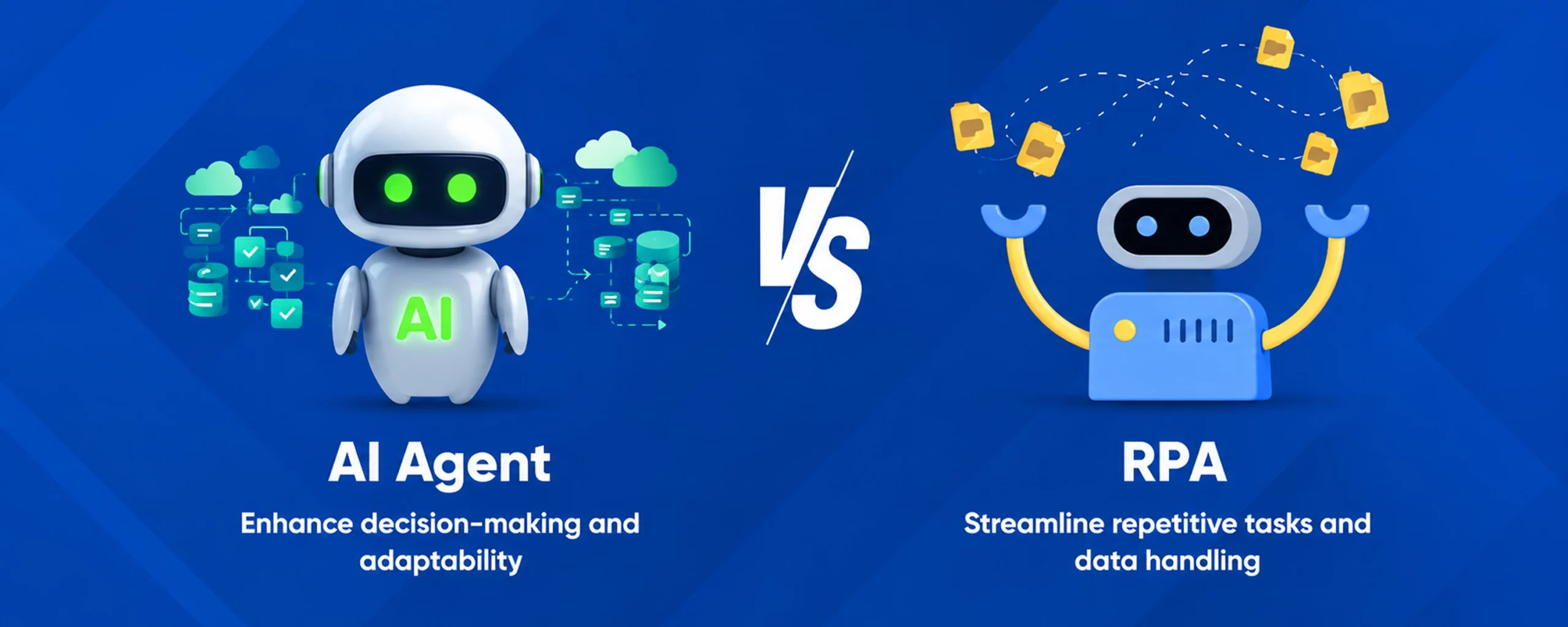
For most of the last decade, RPA was the default answer to “how do we automate this?” Software bots clicked buttons, copied fields, and moved data between systems exactly as programmed. It worked, until something changed.
A vendor updated their interface, a form shifted by ten pixels, or a document arrived in a slightly different layout, and the bot broke. Someone had to fix the script, and the cycle repeated.
AI agents solve a different kind of problem, and by 2026 the shift is no longer a debate happening at the margins. Every major RPA vendor, UiPath, Automation Anywhere, Blue Prism, has spent the past year rebuilding around agent-based architecture.
This guide breaks down what actually separates an AI agent vs RPA bot, where each one holds up, and how to think about the decision if you’re planning your next automation investment.
What RPA Actually Does
RPA, or Robotic Process Automation, uses software bots that mimic human interactions with digital systems. They click, type, copy, and paste through applications exactly the way a person would, following rule-based procedures for tasks like:
- Invoice processing on a fixed template
- Data entry between two systems that never change
- Scheduled report generation from a static dashboard
- Form submissions to government or internal portals
RPA works well because it’s predictable. For structured, repetitive processes on stable interfaces, a bot performs the same action the same way, every time, without variation. The tradeoff is that this reliability disappears the moment anything changes. A bot relying on fixed screen coordinates or specific HTML elements has no way to adapt when a vendor updates their interface, and any deviation from the expected path, known as an exception, typically requires a human to step in and fix it.
What an AI Agent Actually Does
An AI agent is built around a large language model at its core, which gives it the ability to reason, plan, and work with unstructured information rather than just follow fixed steps. Around that reasoning engine sits a set of tools the agent can use, APIs, databases, internal systems, plus memory that lets it retain context across steps or sessions.
The practical difference shows up in how each one handles a real scenario. Where an RPA bot needs every click and wait condition defined in advance, an AI agent can be briefed on an outcome and figure out the steps itself. Tell it to resolve a customer complaint, and it can read the email, pull order history, check the refund policy, decide on a response, and send it, without being told the exact sequence to follow.
This is what’s often described as the shift from task automation to goal automation. Instead of automating a rigid process, businesses are increasingly automating a result and letting the agent determine the path.
RPA can follow rules and mimic human actions, but it can’t think. An AI agent is like briefing a smart contractor on the outcome you want and leaving it to figure out the rest.
Comparing the Two Head-to-Head
| Factor | RPA | AI Agent |
| Core logic | Deterministic, rule-based scripts | Probabilistic reasoning via LLM |
| Handles unstructured data | No | Yes |
| Exception handling | Requires human intervention | Can reason through most exceptions natively |
| Year-one cost (typical) | ~$228,000 | ~$77,000 |
| Maintenance burden | 60-75% of total automation budget | Shifts to improving guardrails, not fixing scripts |
| Best fit | Structured, high-volume, stable processes | Dynamic workflows requiring judgment or context |
| Legacy system access | Strong, works at the UI layer without APIs | Often uses RPA as a tool to reach legacy systems |
Why RPA Isn’t Actually Dead
It’s tempting to read the shift toward AI agents as a full replacement story, but that’s not quite accurate. RPA remains genuinely useful in a specific, narrow lane: structured, high-volume tasks on legacy systems where APIs don’t exist and deterministic accuracy is required. Generating a weekly compliance report from a static dashboard doesn’t need reasoning, it needs consistency.
Even AI-forward companies acknowledge this. Rather than treating RPA as obsolete, the more accurate 2026 framing is that RPA is becoming a tool an AI agent calls on, not the primary orchestrator. If an agent needs to interact with a legacy mainframe that has no API, it can write a script and direct an RPA bot to execute the data entry on its behalf. The bot still does the clicking. The agent decides when and why.
The Real Cost of Sticking with Pure RPA
The financial case for reconsidering a pure-RPA strategy is hard to ignore. A meaningful share of RPA projects, by some estimates 30 to 50%, fail outright, and maintenance alone can consume 60 to 75% of a total RPA automation budget. That’s not a one-time cost either. Every time an underlying system changes, the bot breaks, and someone has to rebuild it, which means the maintenance curve keeps climbing rather than flattening out.
AI agents don’t eliminate maintenance entirely, but the nature of it changes. Instead of “fix the broken script,” the ongoing work shifts to improving guardrails and expanding what the agent is trusted to handle on its own. One cost curve trends upward over time. The other trends downward. That difference compounds significantly at scale.
How Enterprises Are Actually Making the Transition
Very few businesses are ripping out RPA bots that are working fine. The more common, and more sensible, approach follows a simple pattern:
- Keep stable bots running where they’re doing structured, high-volume work reliably
- Redirect new automation requests to AI agents, especially anything involving unstructured data, judgment calls, or frequent exceptions
- Retire the most fragile, high-maintenance bots first, since the savings from replacing them often fund the rest of the transition
This hybrid approach captures the strengths of both: RPA handles efficient, low-cost execution of deterministic tasks, while AI agents provide the reasoning and adaptability that makes an end-to-end process actually autonomous, rather than automated up until the first exception.
Where a Purpose-Built AI Agent Platform Changes the Equation
The challenge most businesses run into isn’t deciding that AI agents are worth adopting, that part is increasingly settled. It’s building agents that are actually reliable enough to run in production, with the reasoning, memory, and tool integrations that make the difference between a demo and a system your team can depend on.
This is where Isometrik AI fits in. Rather than assembling agent logic from scratch or bolting cognitive capability onto an existing RPA stack, Isometrik provides production-ready AI agents built to reason, plan, and handle exceptions natively. A few reasons this matters for businesses moving beyond rule-based automation:
- Pre-built AI teams: Sales, support, and operations agents deployable in 6 to 8 weeks, versus months spent building reasoning and exception-handling logic from the ground up
- Agent Studio for custom workflows: A no-code, drag-and-drop builder for multi-agent systems, so business teams can design and adjust agent workflows without needing a developer for every change
- Persistent context and memory: Agents that retain relevant history across interactions, a core requirement for handling exceptions the way a human would rather than restarting from zero each time
- Voice AI included: Full infrastructure for inbound and outbound voice interactions, extending agentic automation into conversations, not just backend data tasks
- Enterprise-ready governance: Multi-tenant architecture, role-based access, and SOC 2 and HIPAA-ready audit logging built in, so scaling agent adoption doesn’t mean scaling risk alongside it
For businesses that already have RPA in place, this doesn’t mean starting over. It means having a reliable agent layer ready to take on the exception-heavy, judgment-driven work that RPA was never built to handle.
Conclusion
RPA and AI agents aren’t really competing for the same job anymore. RPA still earns its place on structured, high-volume tasks where nothing changes. AI agents take over where reasoning, adaptability, and exception handling matter, which increasingly describes most of the work that used to require a human in the loop.
If you’re building toward AI-driven automation rather than patching together RPA scripts, Isometrik AI gives you production-ready agents built for exactly that, so you can deploy in weeks instead of spending months on a custom build.