AI Appointment Setter: Automating Sales Scheduling for Efficiency

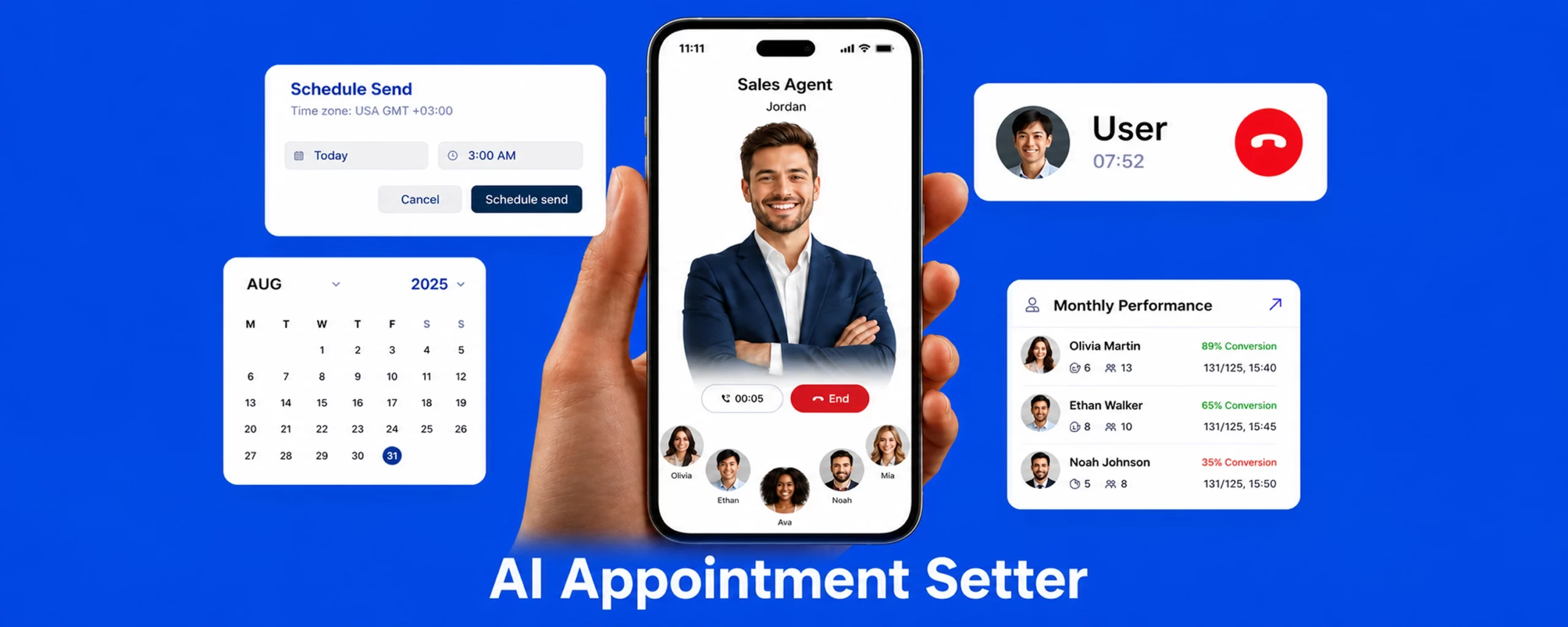
Sales leaders in the US face mounting pressure to accelerate pipelines amid rising costs. Manual appointment setting drains SDR time on routine tasks like follow-ups and calendar checks. An AI appointment setter changes this by acting as a virtual assistant that qualifies leads and books meetings automatically – converting 30% more leads into meetings without the delays of manual outreach.
Understanding the AI Appointment Setter
This technology leverages natural language processing (NLP) and machine learning to mimic human conversations. It scans inbound leads from forms, emails, or social channels, asks qualifying questions, and slots appointments into shared calendars. For mid-market businesses with 50–500 employees, this means handling hundreds of interactions daily without fatigue.
Consider a typical sales workflow: a lead submits a form on your website. Traditionally, an SDR emails back, waits for replies, and manually books if interested. With an AI appointment setter, the system responds in seconds, qualifies intent, and books directly.
Businesses already using CRMs like Salesforce or HubSpot find these tools plug in easily. They pull data on past interactions to personalize outreach, ensuring relevance. In sectors like SaaS, e-commerce, and professional services, adoption is growing as teams seek scalable growth without proportional headcount increases. Early benchmarks show setup costs offset in months — but success hinges on aligning the tool with your specific sales process.
Key Benefits for Sales and Operations Teams
Adopting an AI appointment setter delivers tangible wins for heads of sales and operations. SDR teams often spend 60-70% of time on admin; automation frees them for closing deals.
- Faster Lead Response: Respond to inquiries in under 10 seconds, boosting reply rates by 25–50% and edging out competitors relying on human delays.
- Improved Qualification: Ask targeted questions to score leads, filtering out low-fit prospects and prioritizing hot ones for human reps.
- Reduced No-Shows: Automated reminders via SMS or email cut cancellations by 30–40%, keeping calendars productive.
- Cost Savings: Replace or augment 1–2 full-time setters ($40K–$80K/year salary) with a tool costing $100–$500/month, yielding 50–70% savings.
- 24/7 Availability: Handle global time zones for US firms expanding internationally, capturing leads outside business hours.
For operations leaders, integration with ERP or ATS systems extends benefits to recruitment and customer support. In hiring, it schedules interviews rapidly, shortening time-to-hire by weeks.
| Benefit | Traditional Manual Setting | AI Appointment Setter |
| Response Time | 1–24 hours | Under 10 seconds |
| Conversion Rate | 10–20% of leads booked | 30–40% of qualified leads |
| Monthly Cost (500 leads) | $3,000–$5,000 (staff) | $200–$1,000 (tool + setup) |
| Scalability | Limited by team size | Handles unlimited volume |
A SaaS company processing 1,000 leads monthly might add $50K in pipeline value from better booking rates alone. Start by mapping your current funnel, identify bottlenecks like low response times, then pilot the AI on one channel (e.g., website forms) to quantify lifts before full rollout.
How Does an AI Appointment Setter Work?
At its core, an AI appointment setter processes inputs through intelligent workflows. It begins with lead capture from sources like web forms, LinkedIn messages, or email inboxes. Using NLP, it parses intent — “Interested in demo?” triggers qualification. The system then engages in multi-turn conversations, asking scripted or adaptive questions like “What’s your biggest challenge with CRM integration?” Responses feed into scoring models, routing high-potential leads to booking.
Integration is key. It syncs with Google Calendar, Outlook, or tools like Calendly for real-time slots. For enterprise users, APIs connect to Salesforce or HubSpot, updating records automatically. Voice-enabled versions handle calls via telephony, ideal for outbound sales. Advanced features include sentiment analysis to detect urgency and personalization using CRM data.
- Input Layer: Captures leads from multi-channel sources.
- Processing Layer: Qualifies via AI chat, scores based on criteria like budget or timeline.
- Output Layer: Books slots, sends confirmations, and logs data in CRM.
- Feedback Loop: Learns from outcomes to refine future interactions.
Setup involves defining rules: availability windows, qualification thresholds, and escalation paths to humans. US-based teams benefit from compliance features like GDPR or CCPA adherence built into data handling. Test integrations early — a mismatch with your CRM can delay value; prioritize tools supporting Zapier or native APIs for smooth deployment.
Build vs. Buy: Choosing the Right Approach
Mid-market leaders must weigh building a custom AI appointment setter against buying an off-the-shelf solution. Buying offers speed — platforms deploy in days, with pricing from $29–$149/month for basics, plus pre-built NLP models tuned for sales dialogues and vendor support. However, customization is limited; generic scripts may not fit niche industries like legal or healthcare.
Building custom shines for enterprises needing deep integrations. Developing via platforms like Isometrik AI allows tailoring to your CRM workflows and data privacy needs. Costs range $10K–$50K initially, but ownership avoids vendor lock-in.
| Factor | Buy Off-the-Shelf | Build Custom |
| Timeline | 1–2 weeks | 4–8 weeks |
| Cost | $100–$500/month | $10K–$50K one-time + maintenance |
| Flexibility | Medium (plugins) | High (full control) |
| Scalability | Good for mid-market | Excellent for enterprise |
| ROI Break-Even | 1–3 months | 3–6 months |
A buy decision suits pilots; scale to build if volumes exceed 1,000 leads/month. Audit your tech stack first — if heavy on Salesforce, prioritize buy options with strong APIs. For unique processes, partner with AI consultants for hybrid builds.
Step-by-Step Implementation Guide
Rolling out an AI appointment setter requires a structured approach to minimize disruption.
- Week 1 — Select and Integrate: Choose based on your needs — voice for outbound, chat for inbound. Connect to calendars and CRMs via APIs. Test data flow to ensure leads sync without duplicates.
- Week 2 — Customize Workflows: Script qualification questions aligned to your ICP. Focus on pain points like “pipeline delays” and train the AI on sample conversations for accuracy.
- Week 3–4 — Pilot and Train: Launch on a subset of leads (e.g., 20% volume). Monitor and tweak based on logs, and train reps to handle handoffs seamlessly.
- Week 4+ — Full Rollout: Deploy with an analytics dashboard. Adjust for US-specific nuances like time zones and track engagement metrics weekly.
Budget $5K–$20K for initial setup depending on complexity. Common pitfall: overlooking change management. Involve reps early to build buy-in — pilot results build momentum. For recruitment ops, extend to interview scheduling post-pilot success.
Real-World Case Studies and ROI Examples
US companies are already reaping rewards from AI appointment setters. A mid-market SaaS firm with 200 employees integrated one with HubSpot, automating 70% of inbound scheduling. Appointments rose 35%, the sales cycle shortened by 22 days, and the firm added $150K in quarterly revenue.
In recruitment, a talent ops team at a $50M logistics company used it for candidate screening. Manual resume reviews dropped 60%, time-to-interview fell to 48 hours, and hire rates improved 25%. Cost: $15K custom build, ROI in 4 months via reduced recruiter overtime.
For e-commerce, an ops leader automated customer rebooking. No-shows plummeted 45%, support tickets decreased 30%, saving $20K/month in labor.
| Scenario | Pre-AI Metrics | Post-AI Metrics | ROI Timeline |
| SaaS Sales (500 leads/mo) | 15% booking rate, 30-day cycle | 50% booking rate, 22-day cycle | 3 months |
| Recruitment (300 candidates/mo) | 5-day screening, 20% no-shows | 2-day screening, 10% no-shows | 4 months |
| E-commerce Support (1,000 queries/mo) | 40% manual follow-ups | 15% manual follow-ups | 2 months |
Benchmark against your baselines. Track pipeline velocity pre- and post-deployment to justify expansion.
Common Challenges and Solutions in Deployment
Integration hurdles top the list — legacy CRMs may resist APIs. Use middleware like Zapier initially, then migrate to direct connects. Data privacy concerns arise under US regs like CCPA; opt for tools with encryption and audit logs, and ensure SOC 2 compliance for custom builds.
Adoption resistance from teams fearing job loss is real. Counter with training: show how AI handles grunt work, letting reps focus on relationships. Accuracy dips in complex queries — mitigate with ongoing tuning, allocating 10% of setup time for iterative improvements.
| Challenge | Impact | Solution | Mitigation Cost |
| Integration Delays | 1–2 week setback | API audits pre-purchase | $2K–$5K |
| Privacy Risks | Compliance fines | Built-in encryption | Included in enterprise tools |
| Team Resistance | Slow adoption | Hands-on training sessions | $1K–$3K |
| Low Initial Accuracy | 10–20% error rate | Feedback loops and retraining | Ongoing, 5% of budget |
For CTOs, vendor lock-in looms — choose platforms with exportable models. Budget a 20% buffer for challenges and partner with experts to navigate US-specific tech ecosystems.
Conclusion
An AI appointment setter transforms sales scheduling from a bottleneck to a growth engine. By automating qualification and booking, it delivers measurable ROI for US mid-market and enterprise teams.
Platforms like Isometrik AI help organizations deploy production-ready AI appointment setters tailored to sales workflows, integrating seamlessly with CRMs for rapid ROI and full business control – without the hassle of prolonged development.