Enterprise AI Agent Platform: Pick One That Works Beyond the Demo

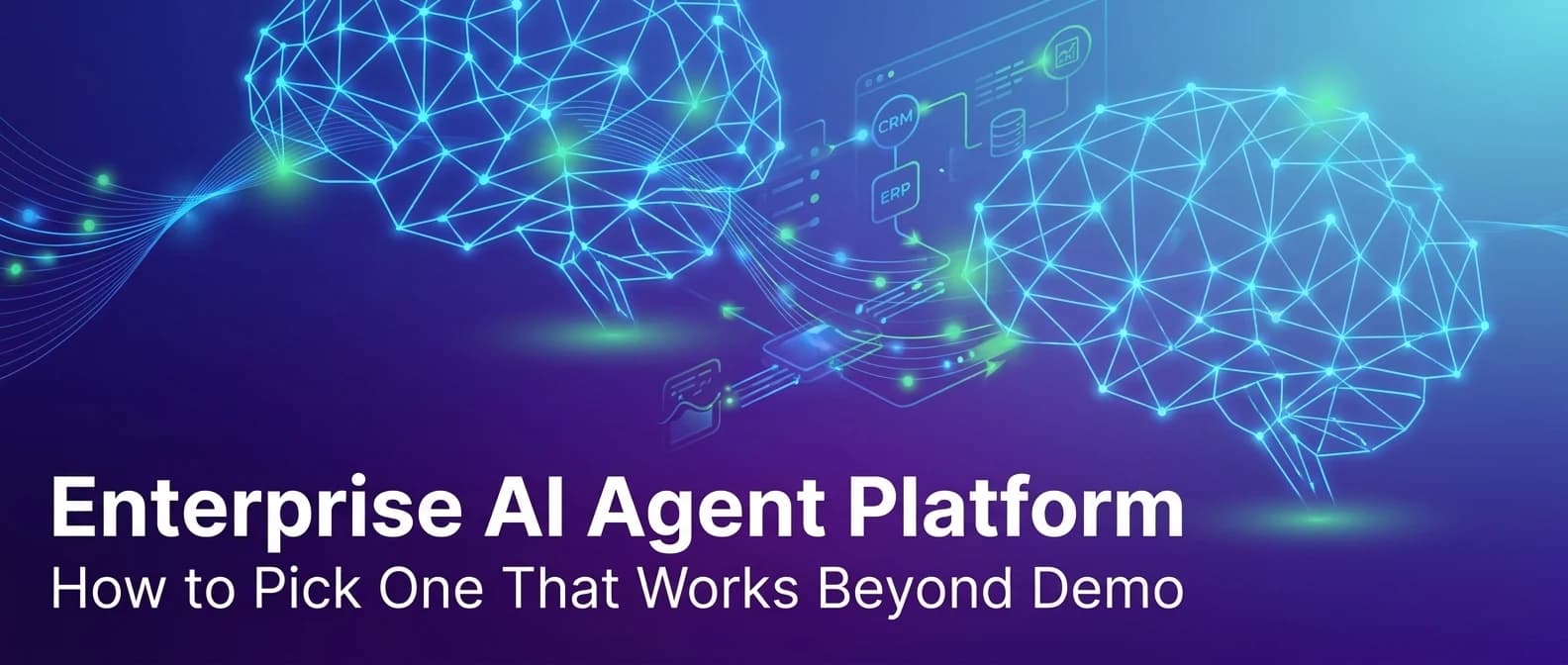
An enterprise AI agent platform is more than a chatbot tool with a corporate price tag. It’s a specialized software framework for designing, deploying, and managing autonomous AI agents. These agents execute multi-step business tasks — across systems, teams, and data sources — with built-in security and governance.
In 2026, enterprise AI agent deployment is no longer an IT experiment — it’s a core business function.
The distinction from basic automation matters. Rule-based bots follow fixed scripts. An AI agent reasons, adapts, and acts based on live data and context. That’s a meaningful difference when you’re running regulated operations at scale.
These platforms also differ from consumer AI tools in a few important ways:
- Agents handle complex, multi-step workflows — not just single queries
- Integration with enterprise systems like CRMs, ERPs, and ticketing platforms
- Governance infrastructure: audit logs, role-based access, and compliance certifications
- Support for multi-agent orchestration, where agents coordinate and hand off tasks
- Data grounding to surface accurate, real-time information and reduce hallucinations
The applications span sales, legal, HR, logistics, and operations. For a deeper look, how AI agents are used in business covers the full range of enterprise use cases.
Why Enterprise Teams Are Going All-In on Agentic AI
The numbers are hard to ignore. Google’s 2026 AI Agent Trends report found that 89% of business teams are already using AI agents. The average organization runs 12 agents simultaneously. That’s not a pilot — that’s infrastructure.
Real production deployments are showing measurable results. Danfoss, an industrial manufacturer, automated 80% of email-based order decisions using AI agents. Response times dropped from 42 hours to near real-time. Suzano, a pulp company with 50,000 employees, cut SQL query time by 95%.
What’s driving urgency isn’t just cost savings — it’s competitive positioning. Companies that deployed AI agents early are running multiple agents across departments. They’re automating decisions that once required analyst bandwidth. The gap isn’t just about speed — it’s about decision quality at scale, without growing headcount.
Enterprise AI adoption is concentrated in a handful of use cases — and those areas are growing fastest.
| Use Case | Adoption Rate | Primary Benefit |
| Customer service automation | 49% | Reduce L1/L2 ticket resolution time |
| Marketing and personalization | 46% | Targeted outreach at scale |
| Security operations | 46% | Faster incident detection and response |
| IT support | 45% | Employee self-service and resolution |
| Business process automation | 64% | Workflow efficiency and cost reduction |
Sources: Google AI Agent Trends 2026; Lyzr State of AI Agents Q1 2026
These numbers also reveal a governance problem. Many organizations that launched AI pilots in 2024 are now stuck at scale. They skipped audit logging and permission controls early on. Now they’re rebuilding compliance infrastructure at full cost and full disruption.
The window for easy wins is narrowing. Teams moving now are compounding advantages. Those waiting are watching competitors pull further ahead.
Core Capabilities Every Enterprise AI Agent Platform Must Have
Not every platform marketed as “enterprise-ready” holds up in production. Most enterprise AI product accelerator failures trace back to the same gaps: weak governance, shallow integrations, and no clear path from pilot to scale.
Before shortlisting vendors, know what you actually need.
- Multi-agent orchestration: Can agents coordinate, collaborate, and hand off tasks in real time?
- Data grounding and RAG support: Does the platform connect to internal data for accurate, context-aware responses?
- Governance and compliance controls: Are audit logs, RBAC, and encryption built in — or improvised later?
- No-code and pro-code flexibility: Can business teams build without IT, while developers extend as needed?
- Native integrations: Does it connect to your CRM, ERP, HRMS, or ticketing tools out of the box?
- Observability and explainability: Can you trace, monitor, and explain every agent action in production?
| Capability | Why It Matters | Red Flag If Absent |
| Multi-agent orchestration | Handles complex, layered workflows | Agents work in silos only |
| Audit logs + RBAC | Required for compliance sign-off | Manual workarounds at every review |
| Data grounding (RAG) | Prevents costly hallucinations | Agents fabricate information |
| No-code builder | Empowers business teams, not just IT | Only developers can configure |
| API/CRM integrations | Connects AI to live business data | Agents run on demo data only |
| Human-in-the-loop | Maintains oversight on high-stakes tasks | Fully autonomous, no guardrails |
Research on Fortune 500 enterprise AI adoption confirms it. Audit trail gaps and permission failures are the top blockers for scaling AI in regulated industries.
Top Enterprise AI Agent Platforms in 2026
The market has matured. A handful of platforms consistently appear on enterprise shortlists. Here’s where each one focuses — and where the gaps tend to show up.
- Google Gemini Enterprise Agent Platform: A broad infrastructure play, formerly Vertex AI. Covers model access, agent governance, and built-in security tooling for organizations on Google Cloud.
- Microsoft Copilot Studio: Deep integration with Microsoft 365 and Azure. A practical fit for enterprises already standardized on Microsoft’s ecosystem.
- Salesforce Agentforce: Purpose-built for customer-facing workflows — service, sales, and commerce. Works best when Salesforce is your primary system of record.
- Kore.ai’s enterprise agent platform: Focuses on contact center automation and conversational AI, with orchestration tools for service-heavy enterprises.
- Moveworks’ employee AI platform: Narrowly built for internal employee support — IT helpdesk, HR queries, and resolution automation. Not a general-purpose builder.
What’s telling is that none of these platforms were designed with the multi-stack mid-market in mind. They’re optimized for enterprises fully committed to a single cloud or CRM vendor. That creates a real gap for businesses managing diverse tech environments.
A detailed comparison of top AI agent builder platforms for enterprises covers 13 vendors and their key integrations.
Each platform has its home turf. Most mid-market and multi-stack businesses don’t live entirely in one ecosystem. That’s where these platforms often struggle to fit cleanly. The right approach matters more than the right brand name.
How to Evaluate the Right Platform for Your Use Case
Before shortlisting, get clear on your constraints. Budget, team technical skill, compliance requirements, and your current tech stack will filter the field quickly. Understanding the difference between agentic AI and traditional automation helps set realistic expectations before any vendor call. The clearer your requirements going in, the faster the evaluation moves.
Ask these questions before you commit:
- Who builds and maintains the agents — IT, business teams, or an external partner?
- What compliance certifications are required: SOC2, HIPAA, GDPR, or FedRAMP?
- How many systems need to be integrated in phase one?
- What’s the expected monthly agent interaction volume at full deployment?
- Does the platform offer a sandbox environment for pre-production testing?
| Approach | Typical Timeline | Cost Range | Best Fit |
| Build from scratch | 6–12 months | $200K–$500K | Complex workflows, large IT teams |
| Buy an enterprise platform | 2–4 months | $50K–$200K/year | Standardized use cases, existing stack |
| Pre-built AI agents | 4–8 weeks | $5K–$25K | Fast deployment, proven use cases |
| Hybrid: pre-built + custom | 6–12 weeks | $25K–$100K | Scaling fast with flexibility |
The guide on how to hire an AI development company covers key questions and costly mistakes to avoid before signing with a vendor.
How Isometrik’s Agent Studio Delivers Enterprise-Grade AI
Isometrik AI approaches the enterprise AI agent platform problem differently. Rather than handing you a self-serve tool and a support ticket queue, Isometrik provides dedicated AI specialists. They build, configure, and deploy agents on your behalf. Your team inherits a working system — and full ownership of it.
The Agent Studio is built for enterprises that need production-ready results in weeks, not quarters.
- Visual drag-and-drop canvas for multi-step, multi-agent workflow design
- 100+ pre-built integrations — CRMs, ERPs, and custom APIs
- Industry-specific templates for sales, HR, legal, healthcare, and operations
- SOC2, HIPAA, and GDPR compliance included — not added after the fact
- RBAC, audit logs, and sandbox testing environments built into the platform
- Context-aware agents trained on your documents, data, and interaction history
Isometrik supports deployment across key verticals — legal, healthcare, e-commerce, logistics, and recruitment — with compliance configurations specific to each industry. Isometrik also provides structured onboarding, so your team can manage and iterate on deployed agents without relying on external support long-term. That matters when regulatory fit is as critical as functionality.
Clients have reported measurable outcomes: a 10x increase in recruiter capacity and 80% improvement in service discovery efficiency. Not ready for a full custom build? Pre-Built AI Teams offer production-ready agents for sales, support, and operations. Deployed in 4–6 weeks.
Making the Right Call on Your Enterprise AI Agent Strategy
Choosing an enterprise AI agent platform isn’t about picking the biggest name in the market. It’s about finding the right match for your workflows, compliance needs, and the team that will own the system long-term.
The platforms that deliver in production share a few clear traits. Strong governance, clean integrations, and a direct path from pilot to scale. Following proven steps to adopt AI in business before locking into a platform prevents costly mid-stream restarts.
Start with one high-impact workflow. Validate ROI with real data before expanding. Once one agent runs cleanly in production, the rest of the stack scales faster.
The criteria are the same across US and global operations: speed to value, compliance fit, and integration with existing systems. If you want to move faster without gambling on the wrong stack, Isometrik AI offers a free strategy session. We’ll help identify the right path — pre-built, custom, or hybrid — and get you live in under 8 weeks.