How AI Agents Handle Objections on Calls Without Losing the Deal

Picture a cold call ten seconds in. The prospect says, “That’s too expensive.” Many reps either fold or push too hard.
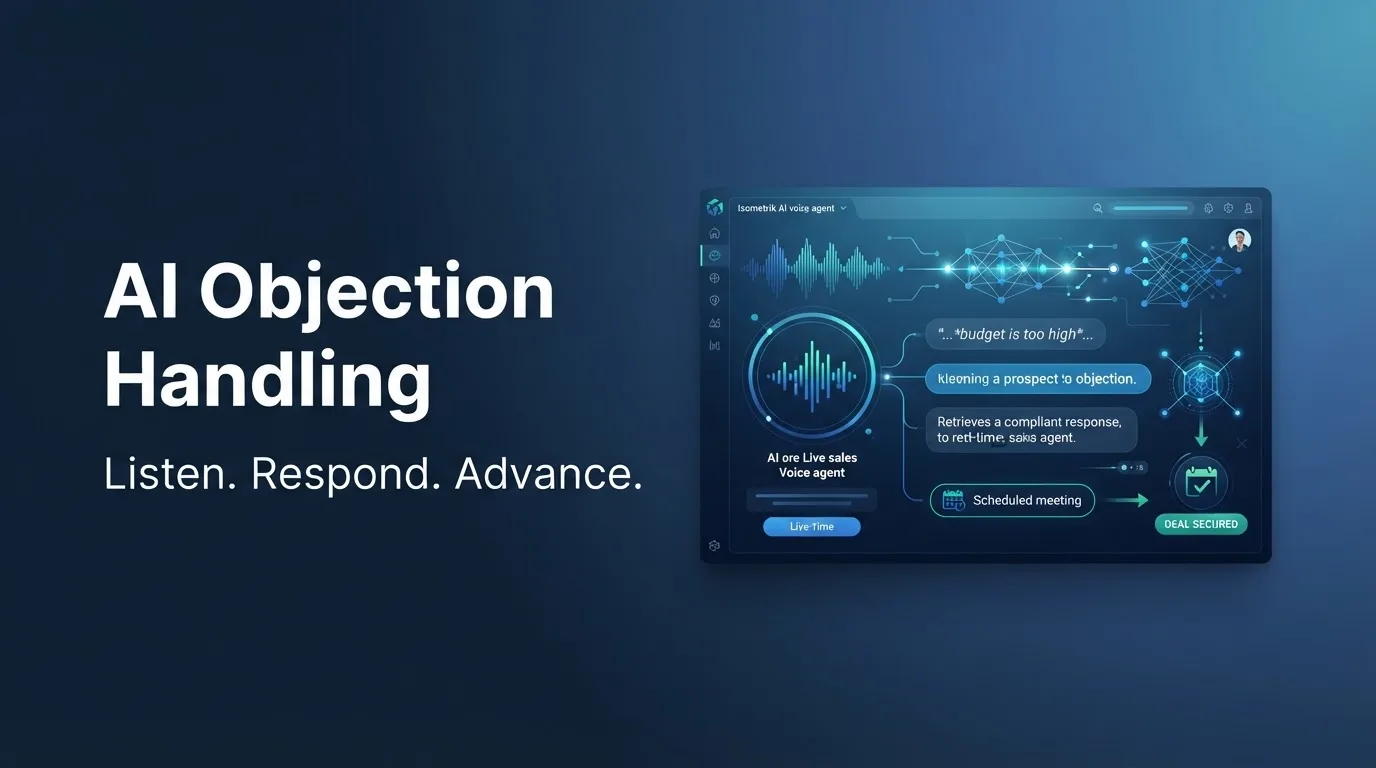
How AI agents handle objections on calls comes down to four steps: listen, classify, answer, and move forward. They work from approved answers and adapt the wording. When the stakes rise, they pass the call to a person with a summary.
This blog shows how that works on outbound sales calls, where it breaks, and how to set it up.
An objection rarely means the call is failing. It usually means the prospect is still listening. Handling it well is where outbound calling is won or lost.
How AI Agents Handle Objections on Calls, Step by Step
Every objection moves through the same short loop. The quality of each step decides whether the prospect stays on the line.
- Listen. Speech-to-text turns the prospect’s words into text while the agent tracks tone and pauses.
- Classify. The agent decides if this is price, timing, trust, competition, or authority pushback. “Send me an email” could be a brush-off or a real request.
- Respond. It answers from approved material, such as pricing language and product facts, and adapts the phrasing.
- Advance. Every reply ends with one small next step, like a callback, a short demo, or a meeting invite.
Intent detection does the heavy lifting in step two. The agent weighs the words, the tone, and the context of the call. “We’re good for now” from a rushed buyer differs from the same phrase after a demo. That difference changes the reply.
Natural language understanding is what separates this from old phone menus. A rigid script breaks when a prospect says, “We’re tightening budgets this quarter.” A modern agent reads that as a timing signal, not a flat no.
Gong’s analysis of sales objections treats pushback as a buying signal. A “too expensive” often means “I can’t see the return yet.” Good agents ask a question before defending the price.
This loop sits at the core of modern AI cold calling software. Inbound calls use it too. Callers there usually raise fit questions rather than brush-offs, so the agent answers more and persuades less.
The Five Objections AI Agents Hear Most
Most pushback falls into five buckets. That predictability is why software handles it well. The table shows how AI agents handle objections on calls of each type.
| Objection | What you hear | How the agent responds | Hand off when |
| Price | “That’s more than we planned.” | Asks what they’re comparing against, then ties cost to outcomes | They ask for discounts or custom terms |
| Timing | “Call me next quarter.” | Asks what’s taking priority, then books a specific callback | No handoff needed |
| Trust | “How do I know this works?” | Shares approved proof points and offers a short demo | They want references or a security review |
| Competition | “We already use someone else.” | Asks what works and what doesn’t, then states differences factually | They raise migration or contract questions |
| Authority | “I need to ask my boss.” | Offers a joint meeting with the decision maker | The decision maker wants to talk now |
Notice that most responses start with a question. Asking what the buyer is comparing against shows the agent is listening. It also surfaces the real blocker, which often differs from the stated one. A price objection can hide a timing problem or a missing stakeholder.
Authority objections deserve special care. The person on the phone often isn’t the decision maker, so booking a joint call beats pushing for a yes.
Buyers are guarded. Gartner’s 2026 survey of B2B buyers found 67% prefer a buying experience without a sales rep. A cold call has to earn its place fast. Honest handling of pushback helps.
One more objection trips up weak setups: “Am I talking to a machine?” Dodging it kills trust. The better move is a short, honest answer and a quick return to why you called. Isometrik AI Cold Calling includes AI disclosure settings, so you decide how the agent introduces itself.
What It Sounds Like in SaaS, E-commerce, and HR
These sample exchanges are illustrative, not real transcripts. Each shows one objection and one good response.
SaaS, competition objection: The prospect says, “We already have a tool for this.” The agent replies, “Good to know. What works well, and what would you change?” If the prospect names a gap, the agent offers a ten-minute walkthrough of that feature.
E-commerce, timing objection: A store owner says, “Not now, it’s peak season.” The agent answers, “Understood. Would the first week of January be better?” It then books that callback and logs it in the CRM.
HR and recruitment, authority objection: A hiring manager says, “I’d need to run this by our HR director.” The agent replies, “Makes sense. Could we set a short call with both of you?” It sends a summary first, so the director arrives informed.
Notice the pattern. Each agent asks a question or offers a small next step. None of them argues. A SaaS buyer, a store owner, and a hiring manager all want to feel heard before they hear a pitch.
What Makes AI Handling Sound Human
Speed and context matter most. A long pause after an objection reads as confusion. Barge-in detection lets the agent stop talking when the prospect cuts in. That is how AI agents handle objections on calls without stalling the conversation.
- Tone reading: Sentiment analysis flags frustration, so the agent can soften its approach or end the call politely.
- Approved knowledge: Answers come from your pricing, FAQs, and comparison notes, not guesses.
- Memory: The agent tracks what was said earlier, so it never repeats a pitch.
- Graceful exits: When a prospect says no clearly, it thanks them and ends the call.
- Language coverage: Support for widely used languages lets one setup serve several markets.
| Situation | Scripted flow builder | Dynamic AI agent |
| Unexpected objection | Falls back to a default branch | Reads intent and adapts |
| Two objections at once | Needs a separate branch built | Can address both in one reply |
| Upkeep | Edit every branch by hand | Update the knowledge base |
| Main risk | Sounds robotic | Can drift without guardrails |
Be honest about limits. Agents can stumble on brand-new objections, heavy background noise, or sarcasm. Some repeat themselves or slip back to a script when a prospect goes off topic. Test these cases before launch, and keep a human fallback ready.
Scripted flows still suit tightly regulated calls. Dynamic agents suit open conversations. Either way, set guardrails: no invented discounts and no made-up features. For more on this topic, see our overview of outbound calling with AI.
When Humans Step In, and What US Rules Require
AI agents handle repeatable objections well. They should not handle everything. Knowing when to stop is part of how AI agents handle objections on calls. Set clear triggers for a handoff.
- Discount requests or custom contract terms
- Legal, security, or procurement questions
- A prospect who sounds angry or confused
- A buyer who is ready to sign
- Any request to speak with a person
A good handoff carries a summary of the objections raised and the prospect’s tone. Nobody repeats themselves. Isometrik AI Cold Calling supports human handoff and warm transfer for this reason.
Track your handoff rate as a health check. If nearly every call transfers, the agent needs better answers.
Compliance belongs here too. In February 2024, the FCC ruled that AI-generated voices count as “artificial” under the Telephone Consumer Protection Act. That means consent rules apply before an AI places a call. Marketing calls generally need prior express written consent.
| Area | What to check | Action |
| Consent | Written consent for marketing calls using AI voices | Keep proof of consent for every number |
| Do Not Call | National and state registries | Scrub lists before each campaign |
| Disclosure | Caller identification and opt-out options | Script a clear AI introduction |
| Other countries | Local consent and calling-hour rules | Review them before dialing abroad |
The FTC’s telemarketing guidance explains which calls fall under its rules. Some business-to-business calls get exemptions. Exemptions don’t cover every case, so have a lawyer review your program. This post isn’t legal advice.
Setting Up Objection Handling With Isometrik AI Cold Calling
Objection handling is only as good as the material behind it. Isometrik AI Cold Calling makes calls, holds natural conversations, handles objections, and books meetings. It records every call, and analytics show which objections come up most.
- Pull your top five objections from past call recordings and rep notes.
- Write short, approved answers for each, plus the pricing language the agent may use.
- Set handoff rules for discounts, legal questions, and requests for a person.
- Choose your AI disclosure wording and your language settings.
- Review call analytics weekly, then add any new objections you find.
Keep each answer short enough to say aloud. Long replies sound like a lecture on the phone. Before launch, test a compound objection, such as “Your price is high, and I’m talking to two other vendors.” Confirm the agent addresses both and returns to the booking goal.
Calls and meetings sync to your CRM, and your team gets Slack or Microsoft Teams alerts. The agent supports widely used languages, which helps when campaigns cross borders. After launch, read a sample of live calls each week. Add every new objection to the knowledge base, and retire answers that stall.
Pair it with the AI SDR Team, so prospects who ignore email outreach can move to a call. Our guide to AI SDR agents shows where email fits. For a wider view, read about AI cold calling software in 2026.
Ready to test it? See Isometrik AI Cold Calling work on your own toughest objections.
Conclusion: Treat Every Objection as a Next Step
How AI agents handle objections on calls is less about clever rebuttals and more about preparation. Listen closely, answer from approved facts, be honest about being an AI, and hand off when stakes rise. Teams that review call data each week keep improving.
Start with your top five objections, test them, and expand from there. AI won’t replace your best rep. It gives every prospect a consistent, honest first conversation and frees your team for calls that need judgment.