How to Choose an AI Voice Platform

The voice AI market has gone from a handful of experimental tools to dozens of platforms, each claiming near-human conversation, sub-second latency, and enterprise-grade reliability. Some of that is true. A lot of it only holds up in a quiet demo room with a scripted call flow, not in production with real callers, background noise, and thousands of concurrent conversations.
Choosing the wrong platform is not a small mistake. Teams that pick based on a polished demo often find themselves rebuilding their voice stack within a year once real call volume exposes the gaps.
This guide walks through the criteria of how to choose an AI voice platform from an impressive pitch.
Start With Latency, Not Features
Latency is the delay between when a caller stops speaking and when the AI responds. It sounds like a minor technical detail, but it is often the single factor that determines whether a caller perceives the system as a real conversation or a broken one.
- Human conversation has roughly 200 milliseconds of natural response gap. Most voice AI systems today operate somewhere between 500 milliseconds and two seconds, and callers have generally adapted to that range.
- Once response time consistently exceeds 900 milliseconds, drop-off increases measurably. A platform that feels acceptable in short demo calls can feel noticeably broken once callers are asking multi-part questions.
- Ask for P95 latency, not average latency. Average numbers hide the worst-case experience, and P95, the response time 95% of callers actually experience, is a far more honest number to evaluate a vendor against.
- Vendor-reported latency is usually measured under favorable conditions. Quiet audio, simple scripts, and low concurrent load rarely reflect what happens once real callers with real accents and real background noise are on the line.
A platform that shines in a demo may struggle in production. Ask what conditions a vendor’s latency numbers were measured under, and at what percentile, before taking the headline figure at face value.
Understand What You’re Actually Paying For
Voice AI pricing is one of the most common sources of buyer frustration, largely because the way it is marketed rarely matches the way it is billed.
- A headline per-minute rate is usually just the orchestration fee. Many platforms bill speech-to-text, the language model, text-to-speech, and telephony as separate line items, which means the advertised rate can be a fraction of the real cost.
- Stacked costs commonly land between two and four times the advertised rate. A platform quoting $0.05 per minute can realistically cost $0.11 to $0.30 per minute once every component is added up.
- Bundled, all-in pricing can be cheaper than it looks. A platform quoting $0.09 to $0.15 per minute with everything included may actually beat a lower headline rate from a build-your-own platform once real usage kicks in.
- Ask about overage tiers and warm transfer costs specifically. Some vendors apply steep pricing jumps above certain usage thresholds, and transferring a call to a live agent sometimes carries its own additional per-minute charge.
- Request an all-in quote covering every component before signing anything. The only way to compare platforms honestly is to get a single number that includes speech-to-text, the language model, text-to-speech, telephony, and any platform fees together.
Test Voice Quality and Interruption Handling, Not Just Accuracy
Transcription accuracy gets most of the attention in vendor marketing, but it is only half of what makes a voice AI system usable in a real conversation.
- Natural-sounding speech synthesis affects trust as much as content accuracy. A caller who can immediately tell they are talking to a robotic voice is less likely to trust the information the system gives them, even if it is correct.
- Interruption and barge-in handling separates production-ready systems from demo-only ones. Real callers talk over automated systems constantly, and a platform that breaks or stalls when interrupted creates a frustrating, unnatural experience.
- Accent and dialect performance still varies significantly across vendors. Test with audio that reflects your actual caller base, not just clean, studio-quality samples, since real-world accuracy often looks very different from a vendor’s published benchmark.
- Background noise handling matters more than most buyers initially test for. Call center environments, mobile callers, and outdoor conversations are rarely as clean as a demo room, and performance can degrade sharply under real acoustic conditions.
Check Integration Depth Before You Check the Feature List
A voice AI platform is only useful if it fits into the systems your team already relies on. Integration complexity is one of the most underestimated factors in how long a deployment actually takes to go live.
- Telephony integration speed varies widely. Some platforms connect to a SIP trunk or existing phone system within hours; others require considerably more custom setup work before a single test call can be placed.
- CRM and helpdesk integration determines whether call data actually becomes useful. A voice AI system that can’t push call summaries, sentiment, and outcomes into CRMs like Salesforce, HubSpot, or Zendesk creates a reporting gap your team will feel immediately.
- Authentication complexity is a real hidden cost. Platforms requiring complex enterprise authentication flows can extend implementation timelines from hours to weeks compared to platforms with simpler API access.
- Ask specifically how call outcomes and transcripts flow into your existing tools. A platform that handles the call well but leaves your team manually logging outcomes afterward has only solved half the problem.
Compliance and Security Should Filter Your Shortlist First
For any business handling customer data over the phone, compliance requirements should narrow the field before performance comparisons even start.
- HIPAA, SOC 2, and GDPR requirements eliminate a meaningful share of vendors immediately. If your business operates in healthcare, finance, or any regulated industry, confirming certification status upfront saves significant wasted evaluation time.
- Data handling and storage policies deserve direct questions, not assumptions. Ask specifically where call recordings and transcripts are stored, for how long, and who has access to them.
- Government and highly regulated deployments face a much smaller vendor pool. Only a limited number of providers hold the highest levels of federal compliance certification, which matters significantly if your use case requires it.
Scale Testing Matters More Than Demo Testing
The gap between a platform that performs well in a proof of concept and one that holds up in production is one of the most common reasons companies end up switching vendors within their first year.
- A platform handling 50 concurrent calls smoothly can degrade badly at 5,000. Public benchmarks rarely test at true production concurrency, which means the only reliable way to know is to test at your actual expected volume.
- Word error rate and latency both tend to shift under real load, not just under clean, low-volume test conditions, so any pilot should include a genuine stress test before a long-term commitment.
- Concurrent call limits vary significantly by tier. Free and entry-level tiers commonly support a small number of simultaneous connections, while enterprise tiers scale much further, and confirming where your expected volume actually lands avoids an unpleasant surprise later.
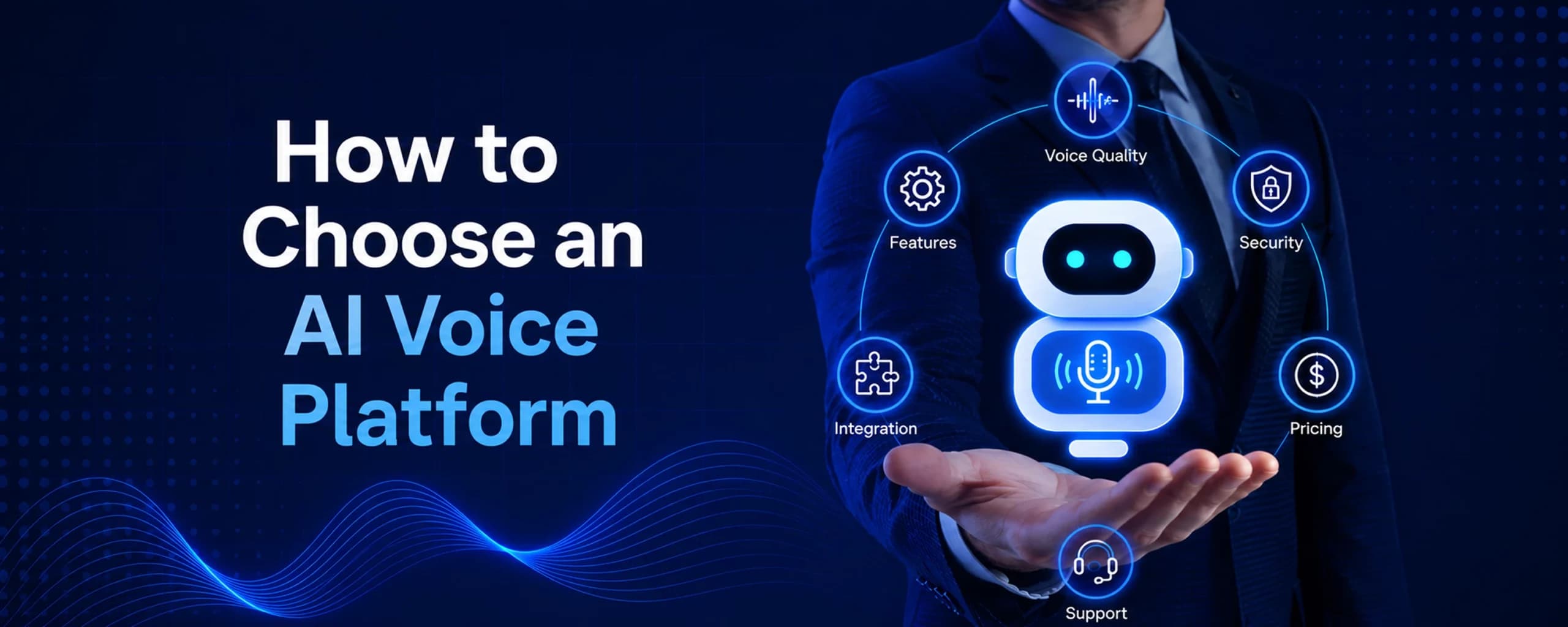
Comparison: What to Weigh When Evaluating Voice AI Options
| Criteria | Why It Matters | What to Ask |
| Latency | Determines if a call feels natural or broken | What is your P95 latency, and under what test conditions? |
| Pricing | Headline rates often exclude major cost components | Can you give an all-in quote covering every component? |
| Voice quality | Affects trust and caller experience beyond accuracy | How does the system handle interruptions and background noise? |
| Integrations | Determines real deployment timeline | How does data flow into our CRM and existing systems? |
| Compliance | Filters the vendor pool before performance matters | Do you hold SOC 2, HIPAA, or GDPR certification? |
| Scale | Exposes gaps demos don’t reveal | Can we stress test at our real expected call volume? |
When to Stop Evaluating Platforms and Start With a Deployed Solution
Working through a full platform evaluation, latency testing, pricing breakdowns, compliance checks, and concurrency stress tests, is the right process for a technical team that wants to assemble and manage its own voice AI stack piece by piece. It is also a genuinely heavy lift, often taking months before a single production call goes out.
For businesses that want the outcome of a well-built voice AI system without owning that evaluation and integration process themselves, the more practical path is a done-for-you deployment built on infrastructure that has already been through this evaluation and hardened in production.
This is where Isometrik AI fits. Rather than asking a business to choose, stitch together, and maintain its own voice AI stack, Isometrik’s Voice AI is deployed as complete, production-ready infrastructure for inbound and outbound calling.
- Human-like conversation across support lines, cold calling, and custom voice use cases, built on infrastructure already tested and refined across real client deployments rather than assembled fresh for each customer.
- Smart escalation to human teams, passing full context and sentiment tracking so a caller never has to repeat themselves after a handoff.
- SOC 2 and GDPR compliance built in, removing the certification-hunting step that typically narrows a platform shortlist.
- Deployed in 6 to 8 weeks, considerably faster than the months a from-scratch platform evaluation and integration process typically takes.
- Predictable, project-based or managed pricing, avoiding the stacked, hard-to-forecast per-minute costs that make DIY voice AI platforms difficult to budget for.
Ready to Skip the Platform Evaluation?
If assembling and maintaining your own voice AI stack sounds like more overhead than your team wants to take on, Isometrik AI delivers production-ready, human-like conversation for inbound and outbound calls, fully built, compliant, and deployed in as little as 6 to 8 weeks.
Book a free strategy call with our team to see what a deployed voice AI solution looks like for your business, or explore Isometrik’s full AI product suite to see what else can be automated.