How Vooma Works for Freight Brokers: The AI Agent Platform Explained

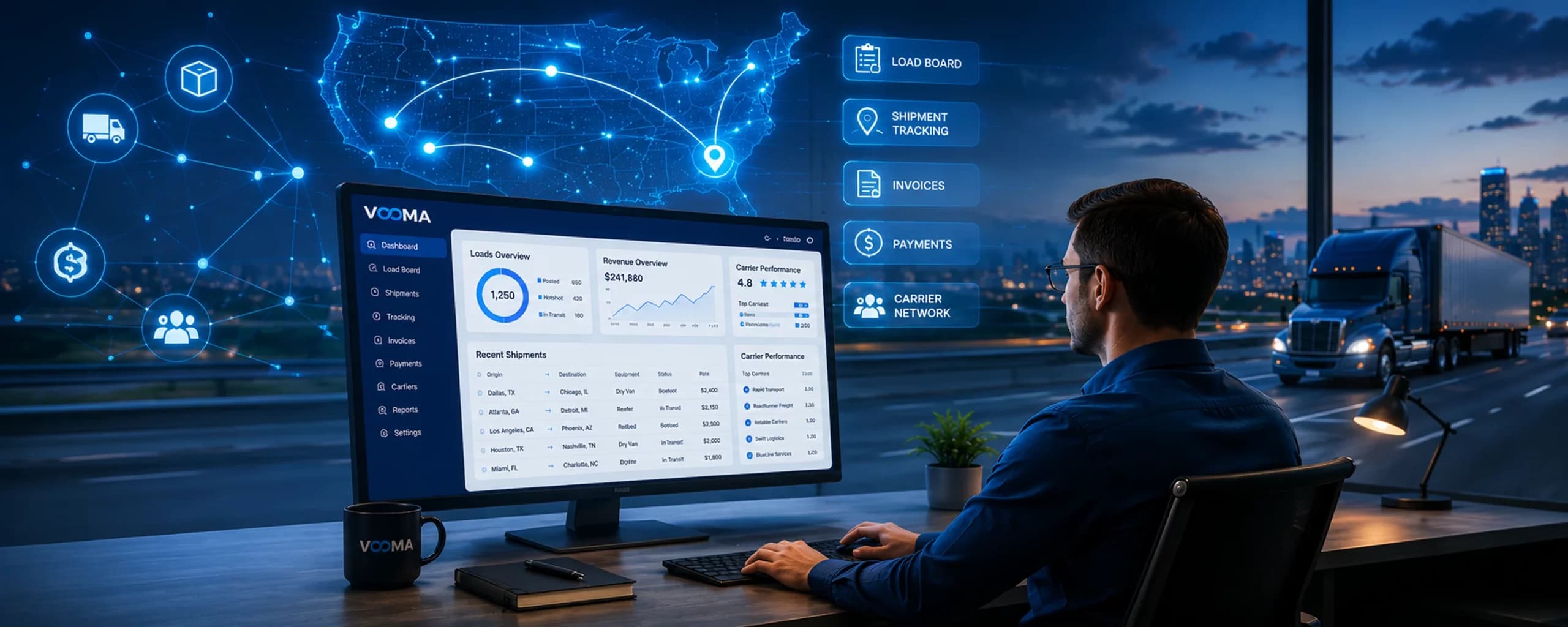
If you run a brokerage, you’ve probably heard the name by now. This blog shows you exactly how Vooma works for freight brokers, what it automates, and what results customers report. We’ll also look at where the category is headed next, and where a broader AI agent strategy picks up where any single tool leaves off.
Freight brokerage is still, at its core, a communication business. Every load moves through a chain of emails, phone calls, texts, and portal logins. Vooma was built to sit inside that chain and do the repetitive parts of the job automatically.
What Is Vooma and How Does It Work for Freight Brokers?
Vooma is an AI agent platform for freight brokers and carriers. Founded in 2022 by Jesse Buckingham and Mike Carter, it went through Y Combinator’s Winter 2023 batch before raising a $13M Series A. Craft Ventures led that round, backing a founding team that combined deep logistics operations experience with autonomous systems engineering from Kodiak Robotics. A later funding round was covered by FreightWaves as the broader freight tech market braced for a shift.
The core idea is simple. Instead of adding another dashboard for reps to check, Vooma puts AI “co-workers” directly into the inbox, the phone line, and the TMS. They read incoming requests, take action, and log everything back into your systems automatically.
That matters because of where the industry’s real bottleneck sits. Roughly 60% of freight orders still arrive as unstructured data — emails, PDFs, and spreadsheets that someone has to manually key into a TMS. Vooma’s founding bet was that large language models had finally made that problem solvable at scale, and the platform grew from there.
The Problem Vooma Was Built to Solve
Order entry is where most brokerages lose the most time. A rep reviews a shipment, checks pricing across multiple systems, and manually enters dozens of data points once the load is won. That process repeats hundreds of times a week per rep.
Tracking has the same shape of problem. Even brokerages with modern telematics still run large in-house or offshore teams to make check calls, because GPS pings alone can’t confirm whether a load will hit its milestone. A rep still has to call and ask.

The founders’ original vision was closer to a universal concierge sitting next to every broker and dispatcher — reading email, responding to opportunities, and making carrier calls on their behalf. That vision has scaled into a full production platform used at brokerages from mid-market to enterprise.
How Vooma Works: The Six Core Modules
Vooma’s platform is organized around the load lifecycle, from the first quote request to final payment. Each module runs as an AI agent working across email, phone, and text at once.
| Module | What It Automates | Reported Impact |
| Quote | Reads inbound quote requests, pulls pricing data, replies to customers | 15% lift in email quote win rate |
| Build | Extracts shipment details from emails/PDFs into the TMS | 90%+ reduction in data-entry errors |
| Cover | Posts loads to DAT/Truckstop, vets and negotiates with carriers | 20–70% of loads booked from inbound calls |
| Schedule | Calls or emails facilities to secure appointment windows | Up to 60% less time spent scheduling |
| Track | Monitors in-transit loads, calls drivers on milestones | 65%+ of inbound calls deflected from reps |
| Collect | Follows up with carriers for proof-of-delivery paperwork | Faster invoicing and payment cycles |
Each agent shares one data layer. What the Cover agent learns booking a carrier informs how the Track agent works that same load, and how the Quote agent prices the next one. That’s a meaningfully different design from tools that bolt AI communication onto a static carrier database.
For carrier reps specifically, this changes the daily rhythm. Instead of spending the first hour of the day dialing through every in-transit load, the Track agent can make those calls at 7 a.m. simultaneously, then hand reps a short list of real exceptions.
If you want the deeper mechanics of that shift, Isometrik AI’s own breakdown of AI agents built specifically for freight brokers covers the broader automation-versus-augmentation decision brokerages face today.
Vooma’s Results in the Real World
Vooma reports it processes roughly 50 million emails and creates 300,000 quotes a month across its customer base. A few named case studies illustrate what that looks like at the brokerage level.
| Customer | Reported Result |
| Evans Transportation | Carrier reuse increased to 75–80% |
| Direct Traffic Solutions | 50–60% of inbound calls handled without a rep picking up; doubled carrier rep capacity |
| Whitewater Freight | Staff-handled calls cut from 2,900/week to 1,150/week in about six weeks |
Across its published customer base, Vooma cites a roughly 5% margin uplift on loads booked through the platform. That’s a meaningful number in an industry where brokerage margins are already thin.
It’s also worth noting Vooma partners with carrier-identity and fraud-prevention platforms like Highway, since faster automation only helps if the carriers on the other end of the call are verified and trustworthy.
Where Vooma Fits — and Where It Doesn’t
Vooma is purpose-built for one job: automating the operational load lifecycle inside a freight brokerage or carrier’s back office. That focus is a real strength, but it also defines the platform’s boundaries.
- It’s built specifically for logistics workflows, not general customer service or sales automation across other industries.
- Its AI agents run the internal quote-to-cash cycle, not necessarily outward-facing brand or customer-experience communication at scale.
- It doesn’t cover functions like B2B prospecting or client acquisition automation for winning new shipper contracts.
- Deployment leans on Vooma’s own team of deployment engineers and strategists, which is valuable but ties you into their implementation model.
- The platform’s roadmap and vertical depth are entirely logistics-specific, which is a tradeoff if a business also needs AI agents elsewhere.
None of that is a knock on the product. It’s simply a reflection of what a logistics-only platform is designed to do, and it’s worth knowing before you commit to one vendor’s ecosystem.
What This Means for Brokers Evaluating AI Tools in 2026
The freight AI category has matured fast. Buyers are no longer choosing between “automation or not” — they’re choosing which architecture fits their operation, and how far that architecture extends beyond logistics.
| Evaluation Question | Why It Matters |
| Does the AI act, or just prepare work for a human? | Determines actual headcount and time savings |
| Is intelligence stored in a database or generated by the work itself? | Affects how current your carrier and pricing data stays |
| Does the platform cover only logistics, or other business functions too? | Matters if you run customer service, sales, or ops outside freight |
| What’s the implementation model — software-only or software plus a team? | Changes your internal staffing requirements |
This kind of AI-agent adoption isn’t unique to logistics, either. Legal teams, e-commerce brands, and SaaS companies are running the same category of automation for their own repetitive, high-volume communication work.
For a wider view of how automation like this plays out across supply chains, Isometrik AI’s guide to logistics automation software and its breakdown of supply chain automation are useful next reads.
How Isometrik AI Extends the Same Idea Further
Vooma solves the internal, operational side of a brokerage extremely well: quoting, order entry, scheduling, and tracking. But a brokerage’s AI needs don’t stop at the back office.
Isometrik AI takes the same “AI co-worker” concept and applies it to the customer- and carrier-facing side of the business, plus the growth side. Its logistics-specific agents handle:
- 24/7 automated shipment tracking and “where’s my shipment” inquiries across phone, SMS, email, and chat
- Proactive exception alerts before a customer even has to call
- Intelligent pickup and delivery scheduling that also optimizes driver routes
- B2B client acquisition — AI-driven prospecting and outreach to win new shipper contracts
- Multilingual support across 100+ languages, useful for brokerages expanding into new regional markets
That last point matters for a US-based brokerage thinking beyond its home market. Isometrik AI’s agents integrate with the same TMS and WMS platforms already in use — McLeod, TMW, Oracle TM, and others — and typically deploy in 6–8 weeks.
If you already run Vooma or a similar tool for internal operations, Isometrik AI’s quoting automation guide is a good starting point for seeing how the customer-facing layer complements it. You can also see the AI in Logistics page directly to explore what that layer looks like for your operation.
Final Thoughts
Understanding how Vooma works for freight brokers comes down to one idea: AI agents doing the repetitive, high-volume work that used to require large teams. Quoting, order entry, scheduling, and tracking are now largely automatable, and the results — from margin uplift to fewer data errors — are well documented.
The next question for most brokerages isn’t whether to adopt AI. It’s how far to extend it — into customer communication, carrier growth, and new markets — beyond what any single logistics tool covers on its own.