AI Agent Durable Execution: Why Agents Keep Crashing (and How to Fix It)

Your AI agent was working fine. Then a server restarted mid-task, and it forgot everything. It re-sent an email, double-charged a customer, or simply stalled forever waiting on an approval that never arrived. This is the quiet failure mode nobody talks about at the demo stage. AI agent durable execution is the fix, and in 2026, it’s quickly becoming a non-negotiable part of any production AI stack.
This piece breaks down what durable execution actually means for AI agents, why it matters more now than it did even a year ago, and how teams are building reliable, long-running agents without hiring a distributed-systems team.
The pressure isn’t unique to any one market. US enterprises are racing to put agents in front of customers, while teams across Europe and APAC face similar reliability demands under stricter data and audit rules. Wherever your business operates, the underlying engineering problem looks the same: agents that run for hours need a way to survive failure gracefully.
What Is AI Agent Durable Execution?
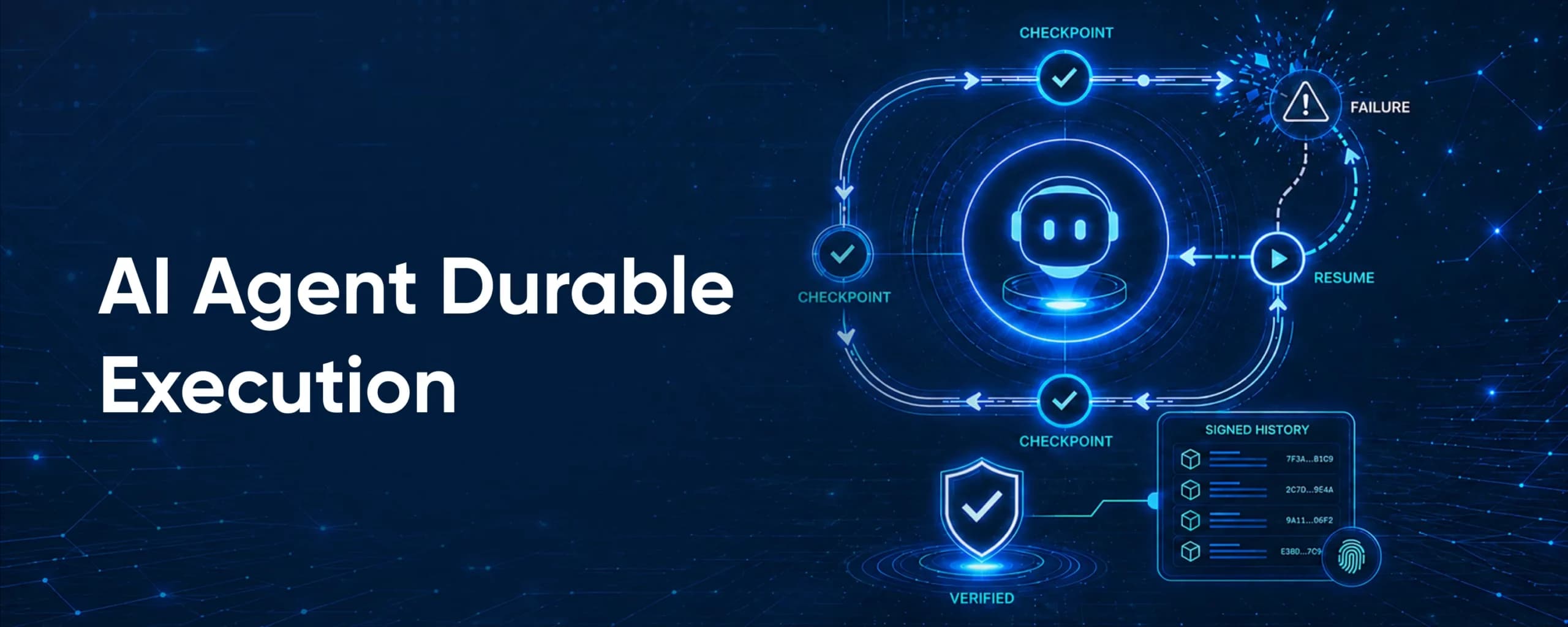
AI agent durable execution is a system design pattern that automatically saves an agent’s progress and state as it works. If a process crashes, a server restarts, or a network call fails, the agent picks up exactly where it left off. It doesn’t restart from zero, and it doesn’t repeat work it already finished.
Think of it as a save point in a video game, except the game saves itself constantly, without you doing anything. Every step, every tool call, every decision gets checkpointed. When something breaks, the agent recovers automatically.
This matters because modern AI agents rarely finish in one shot. They call external APIs, wait on human approvals, and run for hours or days at a stretch. A basic chatbot can afford to fail and restart. An agent processing a loan application, a refund, or a supply chain order cannot.
Why AI Agents Break the Old Rules of Software
Traditional software is deterministic. Feed it the same input twice, and you get the same output twice. If something fails, you retry the whole operation and move on, with no side effects to worry about.
AI agents don’t play by those rules. The same prompt can generate different responses on different runs, which makes a simple retry risky rather than safe. A retried step might duplicate a payment, resend a message, or double-book a meeting instead of cleanly repeating the original action.
Agents also introduce new points of failure that older systems never had to handle:
- Probabilistic outputs that vary between runs, breaking simple retry logic
- Long waits for human-in-the-loop (HITL) approval, sometimes lasting days
- Chained tool calls where one failed step can corrupt the whole workflow
- Multi-agent handoffs where state needs to survive the transfer
- Server crashes or deployments that happen mid-task, not just at the start
Durable execution addresses every item on that list. It treats each agent action as a small, tracked, resumable transaction rather than one long, fragile process. That distinction is the difference between an agent that quietly breaks in production and one your business can actually depend on.
There’s also an observability payoff most teams don’t expect until they see it. Because durable execution logs every step as it happens, engineers get a clear trace of exactly what the agent did, when, and in what order. Debugging shifts from guesswork to reading a timeline. That alone saves hours during an incident, when every minute of downtime has a real cost attached to it.

The Real Cost of Skipping Durable Execution
Teams often discover this gap the hard way, usually after an incident. Here’s how common failure modes translate into real business risk when durable execution is missing.
| Failure Without Durable Execution | Business Impact |
| Server crash mid-workflow | Task restarts from scratch, wasting compute and time |
| Retried payment or refund step | Customer gets charged or refunded twice |
| Approval email never followed up | Workflow stalls indefinitely, no one notices |
| Duplicate outbound message | Customer receives the same email or SMS repeatedly |
| No visibility into agent state | Engineers can’t debug where or why it failed |
Each of these is avoidable. Durable execution gives every workflow a persistent record, so recovery is automatic and each action only ever completes once. That single guarantee, often called exactly-once execution, is what separates a pilot project from something a bank, a hospital, or a retailer can put in front of real customers.
How Durable Execution Actually Works
At a technical level, durable execution systems break an agent’s work into steps. Each step gets logged to persistent storage before it runs. If the process dies partway through, the system replays the log, skips completed steps, and resumes from the last unfinished one.
This is different from simply saving a chat transcript. Durable execution captures the full call stack, local variables, and pending actions, not just the conversation history. That’s what lets an agent resume a payment workflow days later without losing track of where it stood.
Several platforms now offer this specifically for agent frameworks like LangGraph, CrewAI, and Pydantic AI. Here’s how the major approaches compare:
| Platform | Best For | Notable Strength |
| Temporal | Complex, multi-step enterprise workflows | Proven at massive scale (banks, OpenAI, Snap) |
| DBOS | Lightweight, code-first durability | Runs as a library, no separate orchestrator needed |
| Inngest | Event-driven background tasks | Simple step primitives, fast developer setup |
| Azure Durable Task | Multi-language enterprise environments | Native Azure and .NET ecosystem support |
Most of these tools share the same building blocks: a workflow function, individual steps within it, and a signal mechanism for human-in-the-loop pauses. The specific syntax differs, but the underlying promise is identical. Progress is never lost, and nothing runs twice by accident.
Where Durable Execution Shows Up in Real Workflows
This isn’t a theoretical concern reserved for big tech. It shows up anywhere an AI agent takes a real-world action that has to complete correctly.
- Customer refunds: An agent checks an order, escalates high-value refunds to a manager for review, and waits, sometimes for days, before finishing the transaction.
- Document and legal review: Agents processing contracts or compliance checks need to resume mid-review after any interruption, without re-reading from page one.
- Logistics and order routing: A shipping delay or API outage shouldn’t force an entire order workflow to restart from the beginning.
- Recruitment screening: Multi-step candidate evaluations that span days need consistent state across every touchpoint.
- Healthcare intake: Patient workflows involving multiple systems must never duplicate a record or drop a step silently.
In each case, the common thread is the same: the workflow spans time, involves outside systems, and absolutely cannot be allowed to fail silently or duplicate an action.
Build vs. Buy: Getting There Without a Distributed Systems Team
Here’s the tension most teams run into. Durable execution is powerful, but standing it up from scratch means learning workflow engines, managing state stores, and debugging distributed systems edge cases. That’s a steep ask for a team trying to ship a customer-facing agent this quarter, not next year.
This is exactly why more businesses are choosing platforms that bake reliability into the agent-building process itself, instead of bolting it on later. A no-code AI agent builder removes the need to hand-write retry logic, checkpointing, or state management for every new workflow.
Isometrik AI’s Agent Studio takes this approach. It gives teams sandbox testing, one-click rollback, and cloud-native infrastructure that scales from ten interactions to ten million, so agents behave predictably even when something downstream fails. That’s paired with enterprise-grade security, since production reliability and compliance tend to go hand in hand. If you’re evaluating how AI agent frameworks handle reliability, or you’re further along and ready to build and deploy an AI agent, reliability needs to be a day-one requirement, not a retrofit.
Regulated industries feel this pressure first. Teams in healthcare, finance, or legal already know that a SOC2 compliant AI agent platform is table stakes for passing a security review. Durable execution is quickly becoming the same kind of baseline expectation, not a nice-to-have.
The Bottom Line
AI agent durable execution isn’t a niche infrastructure detail anymore. It’s the layer that decides whether your agent is a clever demo or a system your business can actually rely on. As detailed in analysis from DBOS and Inngest, and echoed in reporting from DevOps.com and independent research on agent runtimes, durability has moved from an edge case to a default expectation for production AI in 2026.
The teams shipping agents that customers trust aren’t the ones with the fanciest prompts. They’re the ones whose agents never lose their place, never repeat a payment, and never leave a customer waiting on a workflow that silently died. Whether you build that resilience in-house or through a platform designed around it, AI agent durable execution belongs in your production checklist, not your post-incident review.
Ready to build agents that don’t fall apart under real-world load? Book a free strategy call with Isometrik AI and see how Agent Studio handles durability, security, and scale from day one.