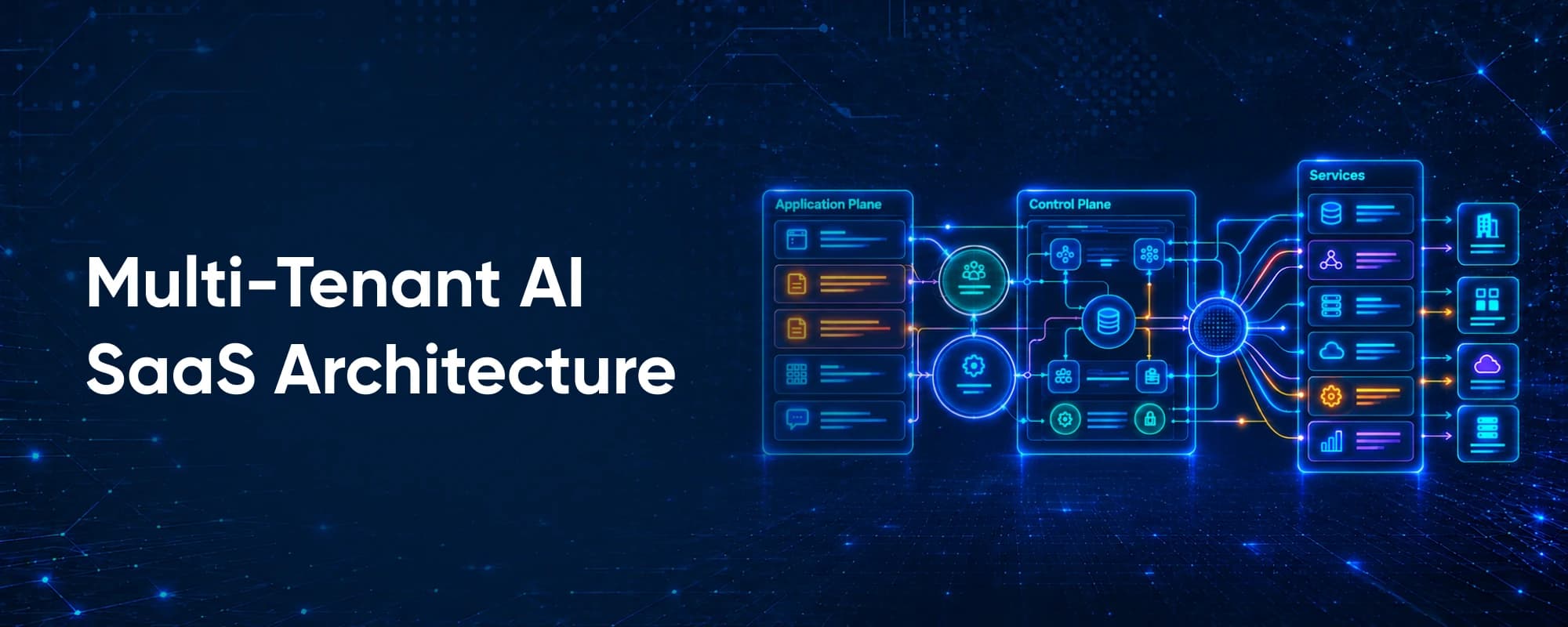
Multi-Tenant AI SaaS Architecture: How to Keep Customer Data, Context, and Costs Separate

Picture a legal tech startup with 50 law firm customers. One firm asks a routine question, and the assistant quotes a clause from another firm’s confidential contract. That single mistake could end the company. Getting multi-tenant AI SaaS architecture right is how you prevent it.
Classic SaaS already lets many customers share one platform. AI adds new places where data, context, and spend can cross customer lines. This guide shows founders and CTOs how to isolate each layer, pick a pattern, and weigh build versus buy. Examples draw on healthcare, legal, and fintech, with a US focus and a global view.
Why Multi-Tenant AI SaaS Architecture Differs From Classic SaaS
In classic SaaS, a tenant is one customer organization. Its users share an application with other tenants. Isolation covers database rows, file storage, and API access. Those controls are well understood.
AI adds three layers that older controls never touched. Each one can leak data or burn budget without throwing a single error. A hospital chatbot, for example, could surface another clinic’s internal protocol. Nothing would crash, so nobody would notice.
| AI layer | What lives there | How it fails |
| Vector embeddings | Document chunks stored as vectors for search | A similarity search returns another tenant’s content |
| Prompt and context | Conversation history, cached prompts, system instructions | A cache serves one tenant’s answer to another |
| Inference cost | Tokens billed on every model request | One heavy account drains the shared AI budget |
Three details explain why these failures stay hidden:
• Embeddings carry no tenant label, so only metadata separates one customer’s vectors from another’s.
• A missed filter in one new retrieval path is enough to expose data.
• Caches keyed only on question text can hand one tenant another tenant’s answer.
• Shared model capacity means one tenant’s batch job can slow every other customer.
OWASP’s Top 10 for LLM Applications names vector and embedding weaknesses and unbounded consumption among its top risks. Both map directly to the layers above. Treat them as design requirements, not afterthoughts.
For founders, this is also a sales issue. Enterprise buyers in healthcare, legal, and finance ask how you separate customer data. A clear multi-tenant AI SaaS architecture story shortens security reviews and builds trust before the contract stage. That edge matters most when several rivals pitch the same buyer.
Three Isolation Patterns: Silo, Pool, and Bridge
AWS’s SaaS Lens groups tenant isolation into three models. In a silo, each tenant gets dedicated resources. In a pool, tenants share resources. A bridge mixes both, so some components are dedicated and others shared.
You make this choice per component, not once for the whole product. Vector storage might be pooled while document storage is siloed. Microsoft’s guidance on multitenant Azure OpenAI lists the factors that drive the decision, including tenant count and compliance requirements.
| Pattern | Best for | Main trade-off |
| Silo: dedicated collection or database per tenant | Regulated sectors like healthcare and fintech, or small tenant counts | Higher cost and upkeep for every tenant |
| Pool: shared index with an enforced tenant filter | Many tenants with moderate isolation needs | One missed filter can leak data |
| Bridge: pooled standard tier, dedicated enterprise tier | Mixed customer bases with enterprise contracts | More routing and operational complexity |
Choosing a pattern is the most important decision in any multi-tenant AI SaaS architecture. A health tech startup with 20 hospital clients leans toward silo. A legal research tool with 2,000 small firms leans toward pool, with dedicated resources for its largest firms.
Consider how a bridge plays out in practice. A fintech platform might pool standard accounts in a shared index. Its largest bank clients get dedicated collections and their own keys. Both tiers run the same codebase, which keeps operations manageable.
One engineering team suggests dedicated collections below roughly 100 tenants and shared collections beyond that. Treat that as a rule of thumb, not a standard. Contracts and regulation often matter more than tenant count.
These questions usually settle the choice:
• How costly would a cross-tenant leak be for your business?
• How many tenants will you serve in three years?
• Do any customers require their own encryption keys?
• Do any contracts require data to stay in one region?
• Will enterprise buyers pay for dedicated resources?
Safeguards That Hold Up in Production
In any multi-tenant AI SaaS architecture, the guiding rule is simple. Enforce isolation in infrastructure, not only in application code. Developers add endpoints every sprint, and any one of them can skip a filter. Infrastructure rules apply whether or not the code remembers them.
These safeguards work together:
• Use row-level security in PostgreSQL so queries return only the current tenant’s rows.
• Keep application roles away from superuser and table-owner privileges, since those can bypass policies.
• Set the tenant ID per transaction, never per pooled connection, so context cannot carry over.
• Wrap vector queries in a client that injects the tenant filter automatically.
• Apply filters inside the search, not after it, or results shrink and relevance drops.
• Put the tenant ID in every cache key, including semantic caches.
• Take tenant identity from the authenticated token, never from model output.
Tenant identity deserves special care. Resolve it once at the gateway from a signed token, then pass it as trusted context to every layer. No component should derive it again from request bodies.
Filter placement is a common flaw in multi-tenant AI SaaS architecture. If you search first and filter afterward, top results come from every tenant’s data. You may get two matches instead of ten, and relevance suffers. Filtering inside the search avoids both problems.
Prompt hardening comes last. Telling a model never to reveal tenant IDs helps, but a determined user can bypass prompts. Database policies simply refuse the query.
Agents that call tools need the same discipline. Store credentials per tenant and resolve them at call time. Reject any tenant identifier the model places inside tool arguments.
Finally, prove it with tests. Seed each test tenant with unique marker documents, then query from every other tenant. Any returned marker should fail the build.
Controlling Inference Costs Per Tenant
Cost control is the layer of multi-tenant AI SaaS architecture that teams add too late. Classic SaaS assumes each extra user costs almost nothing. AI breaks that assumption, because every request carries a token bill. Without limits, one enthusiastic customer can consume a month of budget quickly.
| Control | Where it runs | What it prevents |
| Per-tenant usage tagging | API or LLM gateway | Unknown spend by customer |
| Rate limits and quotas | API gateway | One tenant starving the others |
| Hard budget caps | Gateway with live counters | Runaway batch jobs and agent loops |
| Tier-based model routing | Orchestration layer | Premium models handling simple tasks |
| Separate batch lane | Job queue | Bulk re-indexing slowing live traffic |
Start with these practical steps:
• Tag every model call with tenant, feature, and model.
• Record input, output, and cached tokens separately.
• Alert tenants before they reach a plan limit.
• Cap agent iterations and tool calls per task.
• Keep bulk jobs like re-indexing in a throttled batch lane.
• Show tenants their own usage in a dashboard.
Noisy neighbors need attention too. A bulk re-indexing job from one customer can exhaust shared rate limits. Separate lanes for live traffic and batch work keep interactive features fast. Large tenants can also receive dedicated model capacity.
Cost data also guides pricing. Once you see spend by tenant, you can set plan allowances that protect margins. Visible limits also build trust with enterprise buyers.
Compliance and Data Residency: A US and Global View
US buyers in healthcare, legal, and finance ask about compliance early. Those questions land on your multi-tenant AI SaaS architecture first. HIPAA, SOC 2 reports, and state privacy laws like CCPA shape what you must log and delete. Your isolation design makes those audits easier or harder.
Global customers add residency rules. Many European buyers expect data to stay in the EU, and GDPR restricts transfers outside it. That pushes teams toward regional deployments with a thin global layer holding only tenant metadata.
Offboarding deserves its own plan. AI systems copy data into vectors, caches, adapters, logs, and backups. Keep an inventory of every store that holds tenant data. Run an automated purge when a customer leaves.
Build these in early:
• Log every access with a tenant ID so auditors can trace events.
• Support per-tenant deletion across vectors, caches, backups, and logs.
• Let enterprise tenants bring their own encryption keys.
• Route tenants to region-specific deployments when contracts require it.
Our guide to a SOC 2 compliant AI agent platform explains what auditors look for. This article is general information, not legal advice.
Build or Buy: Where Isometrik’s AI Product Accelerator Fits
Building this layer from scratch takes real time. Tenant identity, role-based access, audit trails, and per-tenant controls all need design and testing. Many teams weigh that effort against launching sooner. Our build vs buy AI platform guide walks through the decision.
Isometrik AI’s AI Product Accelerator helps founders launch their own AI SaaS in 8 to 12 weeks. It includes multi-tenant architecture and IAM with role-based and attribute-based access control. Audit logs are built with SOC 2 and HIPAA in mind. You receive the full source code.
Teams that need infrastructure ownership can deploy on their own stack with BYOK encryption. Our self-hosted AI agent platform guide covers that route in more detail. During scoping, confirm how isolation works for each component. Review those answers against your own compliance obligations.
A secure multi-tenant AI SaaS architecture also needs ongoing care. New features add retrieval paths, tools, and caches that must inherit tenant context. Whether you build or buy, schedule regular isolation tests.
Ask any vendor or build team these questions:
• Where is tenant identity enforced?
• Which components are siloed, pooled, or bridged?
• How is spend capped per tenant?
• How do you delete one tenant’s data everywhere?
• What isolation test results can you show?
Final Thoughts on Multi-Tenant AI SaaS Architecture
Strong multi-tenant AI SaaS architecture starts with one principle. Enforce tenant boundaries in infrastructure, then verify them with tests. Choose silo, pool, or bridge per component, and meter every token by tenant.
Start by mapping the three AI layers and choosing a pattern for each component. Write the tests that prove isolation holds. Then add cost caps before your first large customer arrives.
If you want a faster path to a secure platform, talk to Isometrik AI about launching your own product.