AI Outbound Dialer for B2B Sales: The Complete 2026 Buyer’s Guide

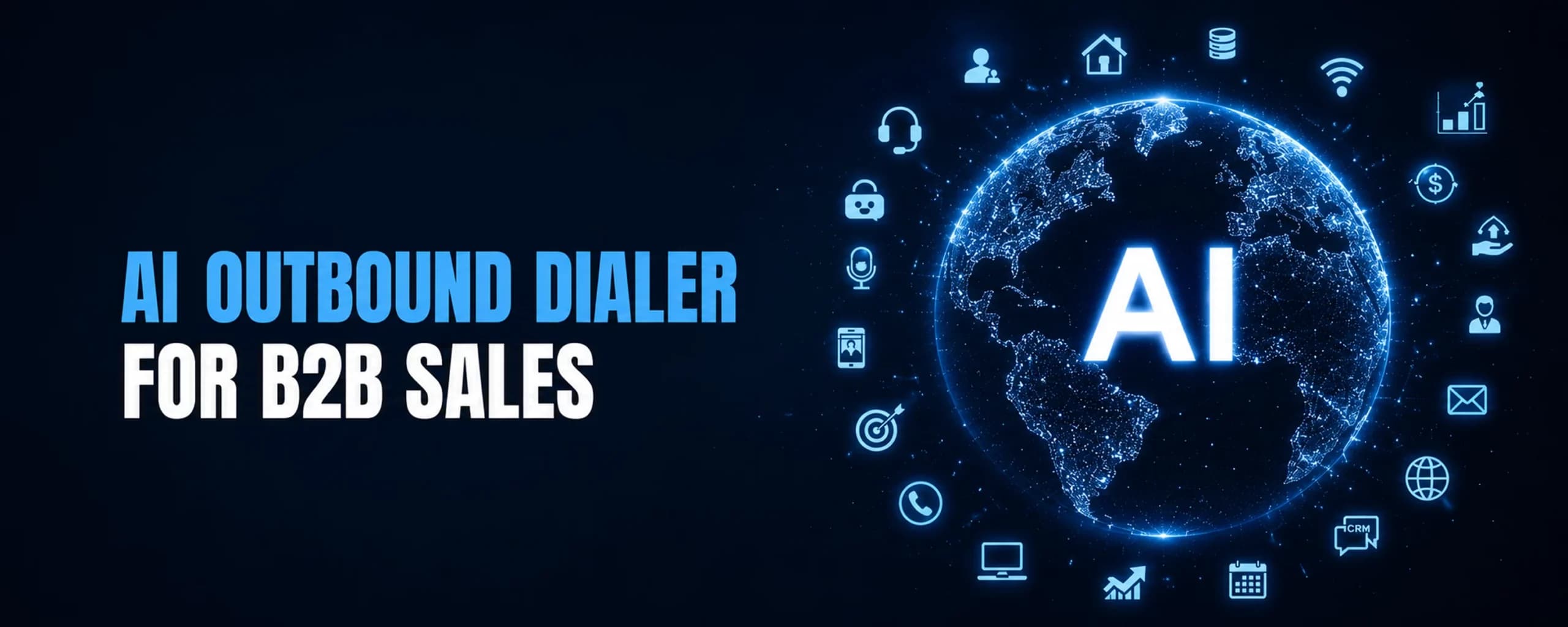
Cold calling isn’t dead, it just got a lot smarter. The right AI outbound dialer for B2B sales can help your team book more meetings without adding headcount. Pick the wrong one, and it becomes an expensive way to generate voicemails and spam-flagged phone numbers. The difference comes down to matching the tool to how your team actually sells.
This blog shows two core types of AI outbound dialers on the market today, the features that separate real platforms from a spreadsheet with a click-to-call button, and the compliance line you cannot afford to cross. By the end, you’ll know exactly what to evaluate before you sign a contract.
Why You Need An AI Outbound Dialer
Outbound calling has become more important, not less, as email inboxes get more crowded and reply rates keep falling across most B2B sectors. Phone conversations still convert better than almost any other channel once a prospect actually picks up.
The bottleneck was never whether the phone works, it was always the manual dialing, the voicemail dead time, and the disconnected data sitting between the call and the CRM.
How an AI Outbound Dialer for B2B Sales Actually Works
An AI outbound dialer for B2B sales automates the mechanical, repetitive parts of cold calling. Reps spend less time dialing and waiting, and more time in live conversations. Some platforms go further and let an AI voice agent run the entire call end to end, greeting the prospect, handling objections, and booking the meeting. Others simply dial faster and connect a live human the instant someone answers.
Both approaches solve the same underlying problem. Sales reps burn hours every week on unanswered calls, voicemails, and busy signals, and that dead time compounds fast across a team. Here’s what’s actually happening under the hood on most modern platforms:
- AI voice agents run LLM-powered conversations that greet, pitch, handle objections, and qualify leads without a rep on the line.
- Parallel and power dialers dial multiple numbers at once and bridge a live rep the moment a human picks up.
- Answering machine detection skips voicemails automatically, so time is never wasted on dead air.
- Warm transfer and call routing hand qualified leads to a human closer along with full conversation history.
- Post-call analytics score every call, generate a transcript, and sync outcomes directly into the CRM.
The best setups combine more than one of these. An AI agent qualifies the top of the funnel around the clock, then routes anything promising to a human rep who closes the deal with full context already in hand.
Teams adopt these tools for a straightforward reason: hiring, training, and retaining human callers is expensive, and turnover on outbound teams commonly runs 30% to 40% annually. An AI outbound dialer for B2B sales doesn’t replace the need for good sellers, but it removes a large chunk of the busywork that burns out the reps you already have.
AI Voice Agents vs. AI Parallel Dialers: Which Model Fits Your Team?
Choosing between an autonomous AI voice agent and a human-assisted parallel dialer comes down to deal complexity and team size. Simple, high-volume qualification calls suit an AI agent that can run unsupervised at any hour, across any time zone.
Complex, relationship-driven B2B deals still benefit from a rep’s judgment on the line, with AI simply clearing the dead time between dials. Most growing sales teams eventually run both models, layered into different stages of the same funnel.
| Factor | AI Voice Agent | AI Parallel Dialer |
| Best for | High-volume, top-of-funnel qualification | Complex deals needing human judgment |
| Who talks | AI handles the full conversation | Human rep, connected only when answered |
| Scaling | Unlimited concurrent calls, no added headcount | Scales with the number of reps on the floor |
| Typical pricing | Pay-per-minute, usually no seat fee | Per-seat monthly licensing |
| Compliance focus | Consent and disclosure during the AI conversation | Abandon-rate limits apply directly |
Neither model is inherently better. A 45-seat lead-gen floor calling purchased lists has very different needs than a five-person SDR team selling six-figure software contracts. Match the tool to the sales motion, not the other way around.
A useful test is to picture your best rep’s actual first call with a promising prospect. If that call depends on genuine rapport and reading the room, a parallel dialer that puts a prepared human on the line will usually outperform a fully autonomous agent.
If the goal is simply confirming interest and collecting a name and email before a human ever gets involved, an AI voice agent can do that job at a fraction of the cost, around the clock.
Key Features That Separate Real Dialers From Glorified Auto-Dialers
Not every tool marketed as an AI outbound dialer earns the label. Some are little more than a contact list with a click-to-call button attached. The features below are the ones that actually move connect rates and rep productivity in real B2B outbound campaigns:
- Real-time objection handling trained on your specific value propositions and pricing.
- Deep CRM sync that logs call outcomes, transcripts, and next steps automatically.
- Branded caller ID and number rotation that prevent “Spam Likely” labeling.
- Sentiment detection that adjusts tone or escalates a heated call to a human.
- Multi-language and regional support for teams running global campaigns.
| Feature | Why It Matters |
| Local presence dialing | Answer rates jump when caller ID matches the prospect’s area code |
| CRM-native logging | Cuts the 8-10 minutes per rep per day lost to manual data entry |
| Voicemail intelligence | Leaves a consistent, personalized message instead of dead air |
| Compliance automation | Scrubs Do Not Call lists and enforces calling-hour limits without manual review |
If a vendor can’t demonstrate these in a live demo, treat it as a warning sign. Feature lists on a pricing page mean far less than watching the platform handle a real objection.
It also helps to ask how the platform learns over time. A dialer that reviews its own transcripts and adjusts pacing, tone, or scripts based on what actually worked will keep improving long after launch. One that stays static will perform on day 100 exactly as it did on day one, regardless of what your team learns in the meantime.
Connect Rates, Compliance, and the TCPA Reality Check
Every AI outbound dialer for B2B sales operates inside the same regulatory guardrails as a human calling team. The FCC caps abandoned-call rates at 3% within any rolling 30-day campaign window, and violations carry real financial exposure.
State-level rules in places like Florida, Oklahoma, and Texas frequently go further than federal law, adding private rights of action that increase litigation risk. A platform that can’t automatically scrub Do Not Call lists and track calling-hour limits isn’t ready for production use.
Connect rates matter just as much as compliance, and the two are related. Industry benchmarks put average B2B connect rates somewhere between 3% and 10%, depending on the sector and list quality. No dialer, however advanced, can fix a bad contact list. What a compliant, well-built platform can do is protect the number reputation and calling cadence that keep your legitimate answer rate from collapsing:
- Automated abandonment tracking that stays under the federal 3% ceiling.
- Do Not Call list scrubbing before every campaign launches.
- State-specific calling-hour enforcement for stricter local jurisdictions.
- Documented consent trails for AI-initiated conversations with prospects.
The financial stakes are real. Individual TCPA violations can run into the hundreds of dollars each, and they compound quickly across a high-volume campaign. Treat compliance tooling as a core evaluation criterion, not an afterthought you check once during procurement.
Rolling Out an AI Outbound Dialer: A Practical Playbook
Deploying an AI outbound dialer well is less about the software and more about the sequence you follow. Teams that skip steps usually end up blaming the tool for a problem that started with bad data or an untrained script. This playbook reflects what actually works across pilot campaigns:
- Audit your current list quality first, since bad data is the single most common cause of dialer underperformance.
- Pick the model, AI voice agent, parallel dialer, or both, based on your deal complexity and team size.
- Train the AI on your real scripts, objections, and pricing, not a generic template pulled from a demo.
- Connect the platform to your CRM before the first live call, not after the pilot ends.
- Launch a small pilot campaign and track connect rate, abandon rate, and rep feedback closely.
- Scale gradually, adding phone numbers while reviewing caller ID reputation on a weekly basis.
Most teams see a meaningful signal within two to four weeks. If connect rates aren’t improving by then, the problem is almost always the list or the script, not the underlying technology.
The most common pitfall isn’t the platform at all, it’s rushing the pilot. Teams that skip the small-scale test and go straight to full volume tend to burn through their best leads before the script or the AI’s tone has been properly tuned. A tighter, shorter pilot with close monitoring almost always outperforms a rushed, full-volume launch.
Choosing the Right AI Outbound Dialer for B2B Sales in 2026
The best AI outbound dialer for B2B sales isn’t the one with the flashiest demo. It’s the one that fits your deal size, protects your number reputation, and proves itself in a real pilot campaign rather than a sales pitch. Before committing, ask any vendor to show live objection handling, CRM sync, and compliance controls in the same conversation.
Isometrik’s AI Cold Calling team handles full outbound conversations, real-time objection handling, and meeting booking, with on-demand infrastructure that improves after every call. It pairs naturally with Isometrik’s AI SDR for email follow-up and AI Prospect Search for lead sourcing, giving your team a complete outbound engine instead of one more disconnected point tool.
For more on how these pieces fit together, this breakdown of tools to automate a sales workflow and this look at how an AI sales agent operates are useful next reads. If your team is ready to scale phone outreach without adding headcount, a strategy call is the fastest way to find out what actually fits.