AI SDR vs Human SDR Cost Comparison for 2026

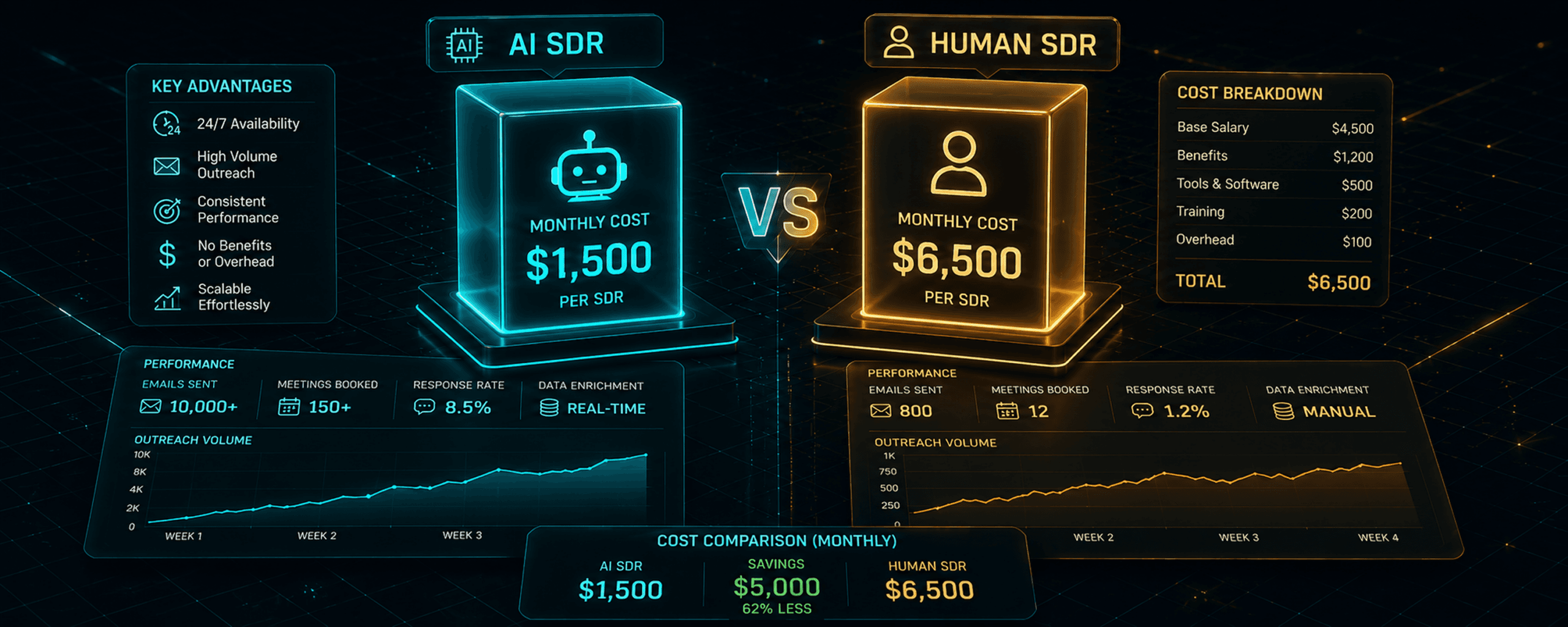
Sales development is the most cost-intensive part of most B2B sales organizations, and it is where AI is delivering some of its clearest ROI. But the comparison between AI SDRs and human SDRs is often reduced to a single number – salary versus software fee – which misses the majority of the real cost difference.
This article does AI SDR vs Human SDR cost comparison. What a human SDR actually costs when all inputs are counted. What an AI SDR delivers and what it costs. Where each performs better. And what the right deployment model looks like for a growth-stage or mid-market sales team.
The True Cost of a Human SDR
Most companies budget for SDR salary plus commission. The actual cost is significantly higher once every input is counted.
Base compensation for a mid-market B2B SDR in the US ranges from $50,000-$70,000 base salary plus $15,000-$25,000 in on-target commission. That puts total cash compensation at $65,000-$95,000 before anything else.
Benefits and payroll taxes add 20-30% on top of cash compensation. Health insurance, dental, vision, 401k match, employer payroll taxes, and paid leave typically add $15,000-$25,000 per SDR per year.
Sales tools and software are often overlooked in per-head cost calculations. A standard SDR tech stack – CRM license, sales engagement platform (Outreach, Salesloft, or equivalent), LinkedIn Sales Navigator, data enrichment tool (ZoomInfo, Apollo, or equivalent), and Zoom – costs $8,000-$15,000 per SDR per year depending on tool selection and negotiated rates.
Management and support overhead is real but rarely attributed to individual headcount. A team of six SDRs typically requires a dedicated SDR manager ($120,000-$150,000 fully loaded) plus regular enablement, coaching, and operations support. Distributed across the team, that adds $20,000-$25,000 per SDR per year in allocated management cost.
Ramp time is perhaps the most underappreciated cost. An SDR hired in January is typically not fully productive until March or April. At a fully loaded annual cost of $100,000+, two to three months of partial productivity represents $15,000-$25,000 in cost without proportional output. Across a team with normal attrition (SDR annual turnover averages 35-40% industry-wide), ramp cost is a persistent drag on team productivity.
Attrition cost compounds the ramp problem. Replacing an SDR costs $10,000-$20,000 in recruiting fees, interviewing time, and onboarding resources – before the ramp cycle begins again.
The full-loaded annual cost per SDR: $110,000-$160,000.
That is the accurate comparison number. Not the salary line.
What an AI SDR Actually Does
Before comparing costs, it is worth being precise about what an AI SDR does – because the scope has expanded significantly from early tools that simply automated email sequences.
A production-grade AI SDR handles:
- Prospect research and qualification – Identifying and scoring prospects against defined ICP criteria, pulling data from LinkedIn, company databases, and intent signals, without a human doing that research manually.
- Personalized outreach generation – Drafting multi-touch email sequences personalized to each prospect’s company context, role, and observed behavior – not mail-merge personalization, but contextually relevant messaging at the individual level.
- Sequence execution and timing optimization – Sending emails at optimal times, spacing follow-ups, and adjusting cadence based on engagement signals.
- Response handling and routing – Categorizing inbound replies (interested, not now, wrong person, unsubscribe) and routing appropriately – booking meetings for positive responses, updating CRM records, and flagging edge cases for human review.
- CRM hygiene – Automatically logging activity, updating contact records, and creating tasks based on sequence outcomes.
- Performance reporting – Surfacing open rates, reply rates, meeting conversion, and sequence-level performance data without manual reporting.
Isometrik AI’s AI SDR covers this full workflow, integrated with existing CRM and email infrastructure, deployed in 4-6 weeks through the Pre-Built AI Teams tier. The system does not replace the sales conversation – it delivers qualified, engaged prospects to the point where a human should take over.
The Full Cost of an AI SDR
AI SDR pricing varies by vendor and scope, but the cost structure is fundamentally different from human SDRs in three ways: it scales without proportional cost increase, it has no ramp time, and the cost is largely predictable.
Deployment cost: Isometrik AI’s Pre-Built AI Teams tier runs $5,000-$25,000 as a one-time setup and integration cost. This covers configuration to your ICP, integration with your CRM and email infrastructure, sequence design, and go-live support.
Ongoing operating cost: Depending on deployment model, this is either a managed service fee or usage-based pricing. At the volume a single human SDR operates, ongoing AI SDR costs are typically $1,000-$3,000/month.
Annual cost equivalent: $17,000-$36,000 per year inclusive of setup amortized over 12 months and ongoing operating costs.
The cost comparison:
| Human SDR | AI SDR | |
| Annual cost (fully loaded) | $110,000-$160,000 | $17,000-$36,000 |
| Ramp time | 60-90 days | Zero |
| Capacity | 50-100 outreach touches/day | Unlimited concurrent |
| Availability | Business hours, 5 days/week | 24/7, no downtime |
| Attrition risk | 35-40% annual turnover | None |
| Performance variability | High – dependent on individual | Consistent by design |
The cost saving on a direct like-for-like comparison is 75-85% annually. But the cost comparison alone understates the advantage because an AI SDR eliminates the capacity and consistency constraints that limit human SDR output.

Where the Comparison Gets More Nuanced
The cost numbers favor AI SDRs substantially. The capability comparison is more nuanced, and being honest about where human SDRs outperform AI matters for designing the right model.
Where AI SDRs outperform human SDRs:
- Volume and consistency. An AI SDR runs the same quality process on the 500th prospect as on the first. Human SDRs tire, rush, and have inconsistent performance across a shift and across a week.
- Availability. AI SDRs respond to inbound signals and send follow-ups outside business hours. Leads that engage at 10pm on a Tuesday get a response before they go to sleep rather than the next morning.
- Data and reporting. AI SDRs generate structured activity data on every touchpoint without any manual logging. The result is a clean, complete picture of outbound performance that most human SDR teams can only approximate.
- Scaling. Adding capacity means configuring additional sequences, not recruiting, onboarding, and ramping additional headcount.
Where human SDRs outperform AI SDRs:
- Complex, high-value account prospecting where the relationship and conversation quality of the initial contact matters significantly. Enterprise deals where the first touchpoint is with a C-suite buyer who will immediately recognize and disengage from automated outreach.
- Novel objection handling in early discovery conversations. AI SDRs handle email sequences well. They are not yet the right tool for an exploratory conversation where the prospect is raising concerns that require judgment and empathy to address.
- Strategic account research where context from multiple signals – news, personal relationships, competitive intelligence – needs to be synthesized into a personalized approach that goes beyond ICP matching.
The Right Model: AI and Human SDRs Working Together
The framing of “AI vs human SDR” is the wrong question for most sales organizations. The right question is: which tasks should AI handle, and which should humans own?
The answer that works in production deployments – including Isometrik AI clients who achieved a 63% reduction in email outreach effort and a 42% increase in lead-to-meeting conversion – is a division of labor where:
- AI SDR handles all high-volume outbound prospecting, initial personalized outreach, multi-touch follow-up sequences, CRM logging, and response routing.
- Human SDRs focus exclusively on qualified conversations – following up on AI-generated positive replies, running discovery calls, handling complex objections, and moving opportunities through the early pipeline.
The result is a human SDR whose time is spent almost entirely on the highest-value activity – conversations with interested prospects – rather than the research and outreach volume that currently consumes 60-70% of most SDRs’ working hours.
This model does not reduce headcount as a first objective. It increases the output per human SDR by removing the lowest-value work from their plate, which in practice means a smaller SDR team with higher per-person productivity and a cleaner pipeline.
What to Evaluate Before Deploying an AI SDR
Not every outbound motion translates equally well to AI-assisted prospecting. Four factors determine how quickly an AI SDR delivers ROI:
- ICP definition clarity. The more precisely the ideal customer profile is defined – firmographics, technographics, intent signals, buying triggers – the better the AI SDR’s prospect selection and the higher the relevance of outreach. Vague ICPs produce high volume and low conversion. Sharp ICPs produce lower volume and significantly higher conversion.
- Existing CRM and email infrastructure. AI SDRs perform best when integrated with a clean CRM that has accurate contact data and when email infrastructure has been properly warmed and authenticated. Deploying an AI SDR into a poor data environment produces poor results regardless of the AI quality.
- Sequence design. The messaging, cadence, and touchpoint structure of the outbound sequence determines whether the AI SDR converts at a rate that justifies the investment. Isometrik AI’s deployment process includes sequence design as part of the setup, which is where most of the performance difference between well-configured and poorly-configured AI SDRs originates.
- Human handoff process. An AI SDR that generates positive replies but has no clear handoff protocol to a human SDR loses the opportunity. Defining exactly what happens when a prospect responds positively – who gets notified, what context is surfaced, what the next step is – needs to be designed before deployment, not after.
The Bottom Line
The AI SDR vs human SDR cost comparison is clear: a fully loaded human SDR costs $110,000-$160,000 per year. A production-grade AI SDR from Isometrik AI runs $17,000-$36,000 per year, deploys in 4-6 weeks, and has delivered a 63% reduction in outreach effort and a 42% increase in lead-to-meeting conversion for clients in production.
The right model is not replacement – it is reallocation. AI handles volume. Humans handle conversations. The result is a more productive, lower-cost, more consistent outbound motion than either approach delivers independently.
Book a free strategy call with Isometrik AI to map your current outbound workflow to the right AI SDR configuration and get a realistic cost comparison for your specific team size and target market.