Multi-Agent Orchestration Platform: What It Is, Why It Matters, and How to Deploy One

Most businesses deploying AI in 2026 are still using it the same way they used software tools in 2015 – one task at a time, with humans stitching the steps together. An AI writes a draft. A human reviews it, copies it into another tool, triggers the next step, waits for output, and moves it along. The AI is faster than doing it manually, but the workflow is still fundamentally human-operated.
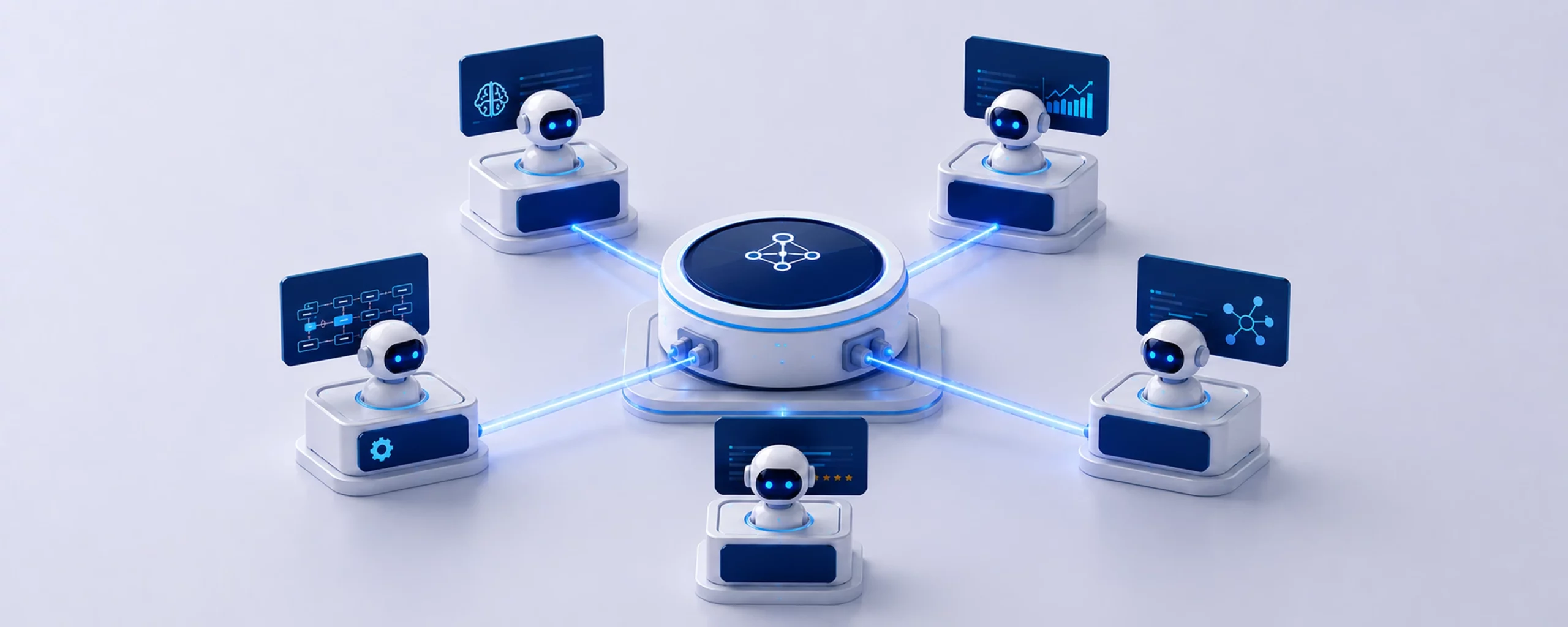
Multi-agent orchestration is what changes that. Instead of a single AI handling one discrete task, a multi-agent system deploys several specialized agents that each own a step in a workflow, pass results to each other automatically, and operate in parallel where tasks allow. The human sets the goal. The agents execute the entire workflow.
This is not a marginal improvement on single-agent AI. It is a different category of capability – and it is what serious AI deployment looks like in 2026.
What Multi-Agent Orchestration Actually Means
A multi-agent orchestration platform is a system that coordinates multiple AI agents to complete a goal that requires more than one type of reasoning, data access, or action.
A single AI agent is good at one thing: answering a question, generating a document, classifying an input. When the task requires several sequential or parallel steps – research, then outreach, then follow-up, then CRM update – a single agent either handles them sequentially (slowly) or cannot handle them at all without human intervention at each handoff.
A multi-agent system solves this by assigning each step to a specialized agent:
- A research agent pulls prospect data from multiple sources and qualifies it against defined criteria
- An outreach agent drafts and sends personalized messages based on the research output
- A follow-up agent monitors responses and triggers next steps based on reply content
- A CRM agent updates records, creates tasks, and logs activity throughout
Each agent operates within its specialization. The orchestration layer coordinates sequencing, handles outputs and inputs between agents, manages errors, and ensures the workflow completes end to end. The result is a workflow that runs faster, more consistently, and at higher volume than any single agent or human team could achieve.
Where Multi-Agent Systems Deliver Real Business Value
The clearest business case for multi-agent orchestration is in workflows that are high-volume, repeatable, and currently require multiple human handoffs to complete. The more steps in the workflow, the more a multi-agent system outperforms a single agent or a human team.
Sales and outbound prospecting is the most common entry point. An orchestrated system handles prospect discovery, qualification, personalization, outreach sequencing, and CRM sync without a human touching any step until a prospect responds. Isometrik AI’s AI SDR and Prospect Search agents work in combination as exactly this kind of multi-agent outbound system.
Recruitment and talent acquisition is a high-value use case because the workflow has many discrete steps – sourcing, screening, ranking, outreach, scheduling – each of which benefits from specialization. The recruiter defines criteria. The agents handle sourcing through to shortlist.
Customer support and service operations benefit from orchestration when resolution requires multiple steps – identifying the customer, pulling their account history, diagnosing the issue, generating a response, updating the record, and triggering any follow-up actions. A single agent handles one of these steps. An orchestrated system handles all of them in one call.
Content and marketing workflows – researching a topic, drafting content, optimizing for SEO, scheduling distribution, monitoring performance – are naturally multi-step and benefit from specialized agents at each stage.
Complex vertical workflows in legal, healthcare, logistics, and manufacturing have steps that require domain-specific reasoning at each stage. AI research tools reduce case prep time by 70% in legal. AI routing lowers delivery costs by 25% in logistics. These outcomes require orchestrated multi-step processes, not single-task AI.
The Architecture Behind a Multi-Agent Orchestration Platform
Understanding what makes a multi-agent platform work helps when evaluating options or explaining the technology to stakeholders.
A production-grade multi-agent orchestration platform needs:
- Agent specialization – Individual agents trained or prompted for specific tasks, with access to only the data and tools they need for their function. Specialization improves accuracy and makes agents easier to test and iterate independently.
- Workflow orchestration layer – The coordination system that defines task sequencing, manages dependencies between agents, handles parallel execution where tasks can run simultaneously, and routes outputs from one agent to the input of the next.
- Tool and API integration – Agents need to act, not just reason. Production agents connect to CRMs, databases, communication platforms, scheduling systems, and external APIs. The orchestration layer manages these connections and handles authentication, rate limiting, and error recovery.
- State management – In a multi-step workflow, context needs to persist across agents. The orchestration platform maintains workflow state so each agent has access to everything that happened before its step.
- Human-in-the-loop controls – Production systems need well-defined escalation points where humans review, approve, or override before the workflow continues. The orchestration layer defines and enforces these gates.
- Observability and logging – Audit trails for every agent action, input, and output. This is a compliance requirement in regulated industries and a debugging requirement everywhere else.
Building this infrastructure from scratch – the orchestration layer, the integration framework, the state management, the observability tooling – takes months and requires specialized AI engineering expertise. Most businesses are better served by deploying on a platform that has already solved these problems.
Isometrik AI’s Agent Studio: Visual Multi-Agent Orchestration
Isometrik AI’s Agent Studio is the multi-agent orchestration layer at the core of the platform. It provides a visual, drag-and-drop interface for building multi-agent workflows without writing orchestration code – while still supporting full API integrations for agents that need to interact with external systems.
Key capabilities:
- Visual workflow builder – Drag-and-drop design of multi-agent flows, with each agent represented as a configurable node in the workflow graph
- Pre-built templates – Ready-made agent workflows for common use cases across sales, support, marketing, operations, and vertical-specific processes
- Multi-agent coordination – Built-in sequencing, parallel execution, and dependency management between agents
- API integration layer – Native connectors to CRMs, email platforms, databases, and third-party tools, so agents act on real business data
- No-code configuration – Non-technical team members can build and modify workflows using the visual interface, without requiring engineering involvement for every change
This means a multi-agent workflow built in the Agent Studio can connect to inbound voice handling, outbound calling campaigns, and CRM systems in the same platform without custom integrations between separate tools.
Three Deployment Models
Isometrik AI offers three ways to deploy a multi-agent orchestration platform, depending on ownership preferences, technical capacity, and compliance requirements.
Full ownership model – Isometrik builds the platform and you own it completely. Full source code, your infrastructure, BYOK encryption, one-time project cost. No recurring platform dependency. This is the right model for businesses that want to build a proprietary AI capability or launch an AI SaaS product. The AI Product Accelerator includes multi-tenant architecture, Agent Studio, voice AI, and 50+ pre-built features, with an 8-12 week delivery timeline.
Managed AI-as-a-Service – Isometrik manages all infrastructure, updates, scaling, and 24/7 monitoring. You focus on the business outcomes. This is the right model for mid-market businesses that want production AI without an internal AI engineering team.
Hybrid agents-as-a-service – Mix pre-built Isometrik agents with your own custom agents in the same orchestrated workflow. Useful for businesses that have existing AI investments and want to extend them rather than replace them.
All three models are available from $5,000 for pre-built agent deployment to $300,000 for full custom platform development, with a 4-16 week deployment timeline depending on scope.
How to Start With Multi-Agent Orchestration
The most common mistake businesses make when approaching multi-agent AI is trying to automate everything at once. A better approach follows three stages:
Stage 1 – Identify one high-value workflow. Look for a workflow that is high-volume, repeatable, currently involves multiple human handoffs, and has a clear measurable outcome (cost per lead, time-to-hire, support ticket resolution time). This is your first orchestration target.
Stage 2 – Deploy a focused multi-agent system. Define the agents needed for each step of that workflow, the integrations required, and the human oversight points. Deploy in weeks using pre-built agents where available, custom agents where the workflow is specific to your business.
Stage 3 – Measure and expand. Track the outcome metric before and after deployment. Use the results to build the internal case for expanding orchestration to adjacent workflows. Most businesses that start with a single high-value workflow expand to three to five within twelve months.
Isometrik AI’s free strategy session is designed exactly for this starting-point conversation – mapping one high-impact workflow to the right agent architecture, estimating deployment time and cost, and defining the measurable outcome that justifies the project.
The Bottom Line
A multi-agent orchestration platform is the infrastructure that turns AI from a point tool into a business system. Single agents save time on individual tasks. Orchestrated multi-agent systems eliminate entire categories of manual workflow – running faster, more consistently, and at volumes no human team can match.
Isometrik AI’s Agent Studio gives businesses a visual, production-ready way to build and deploy multi-agent workflows without months of custom infrastructure development. Three deployment models – full ownership, managed service, or hybrid – mean the right commercial structure is available regardless of technical capacity or budget.
Book a free strategy call with Isometrik AI to map your first multi-agent workflow and get a deployment timeline and cost estimate.