Self-Hosted AI Agent Platform: How to Choose the Right One in 2026

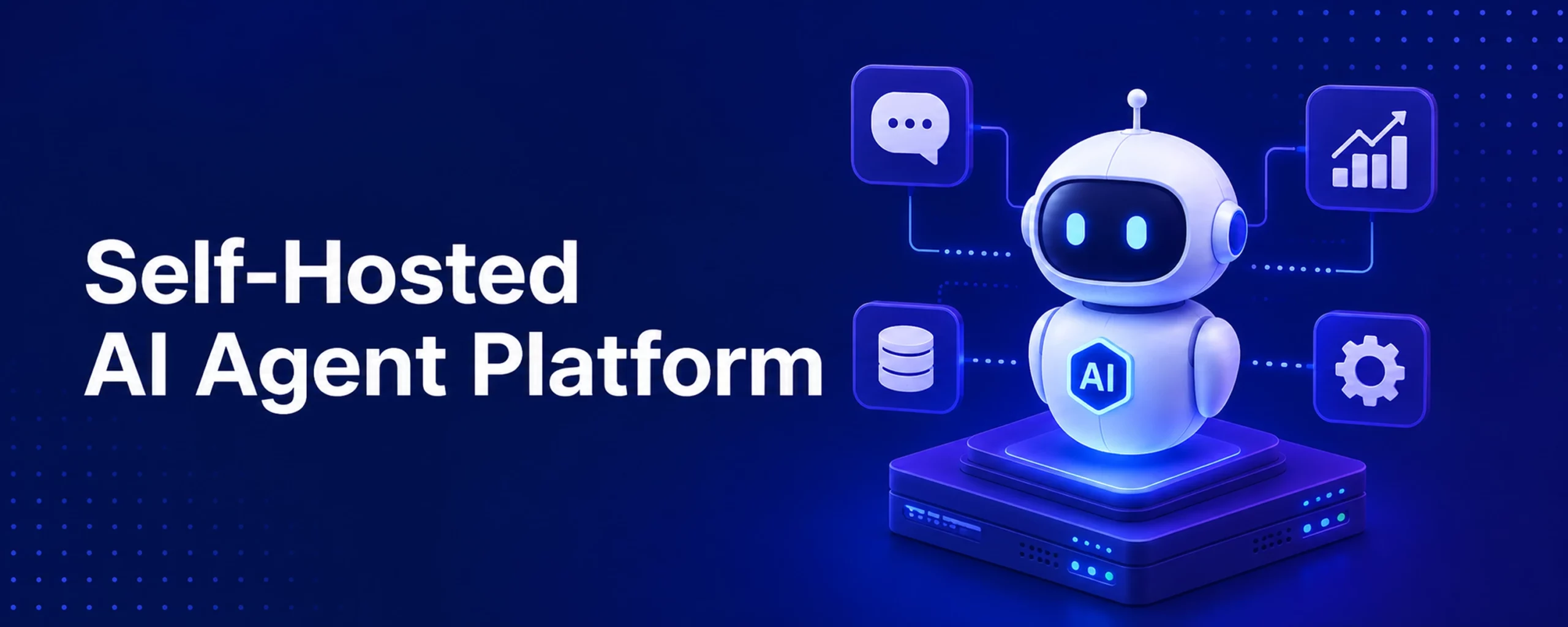
A self-hosted AI agent platform runs on infrastructure you control, not a vendor’s cloud. That means your servers, your VPC, or your own data center. For teams in healthcare, finance, or legal, that distinction isn’t a technical footnote. It’s often the difference between passing a security review and stalling one.
The category has grown crowded fast. Open-source frameworks, low-code builders, and workflow tools all claim the “self-hosted” label, but they mean very different things by it. Some hand you the entire codebase. Others keep the important parts locked behind a paid tier.
This guide breaks down what actually qualifies. It compares the leading options and helps you decide whether to build your own stack, or own a platform outright. We’ll flag a few US-specific considerations along the way, since data residency rules can vary by state.
What Is a Self-Hosted AI Agent Platform?
A self-hosted AI agent platform lets you run, build, and manage autonomous AI agents on infrastructure you own. That could be a local server, a private cloud, or your company’s VPC. The agents handle tasks like answering support tickets, processing documents, or triggering workflows across your business systems.
The core appeal is control. Your data never leaves your environment unless you decide it should. You choose the models, the integrations, and the security posture. No vendor sets usage limits or changes pricing on you mid-contract.
That control comes with a tradeoff, though. Someone on your team now owns deployment, scaling, and every future update.
The term also covers a wider range of setups than people expect. A self-hosted AI agent platform might mean a single Docker container on a laptop. Or it could mean a full Kubernetes cluster spanning multiple regions.
Small teams often start with the simplest version and scale up as usage grows. Larger organizations tend to plan for the full production footprint from day one.
Why Businesses Are Moving Toward Self-Hosted AI Agents
Regulated industries were early adopters, but the reasons now extend well beyond compliance checklists. Cost, latency, and long-term ownership all factor into the decision.
Common drivers include:
- Data residency requirements that keep customer records inside a specific region or network
- Security reviews where “it lives in our own VPC” is an easier answer than “it lives with a vendor”
- Lower per-request costs at scale, since you’re not paying markup on every API call
- Freedom to swap models or providers without rebuilding your entire stack
- Full ownership of the code, so a vendor’s roadmap change can’t strand your workflows
Here’s how self-hosted and managed cloud agents typically compare:
| Factor | Managed Cloud Agent | Self-Hosted AI Agent Platform |
| Data location | Vendor’s servers | Your infrastructure |
| Setup speed | Fast, minutes to hours | Slower, requires DevOps work |
| Ongoing maintenance | Handled by vendor | Handled by your team |
| Compliance control | Limited to vendor’s certifications | Fully within your control |
| Cost at scale | Per-request markup | Infrastructure cost, no markup |
Neither option is universally better. It depends on whether your team has the bandwidth to operate infrastructure, not just use it.
Latency is another factor that gets overlooked early on. Processing data locally, closer to where it’s generated, can shave meaningful time off every agent response. For customer-facing use cases, that difference is often noticeable. It’s rarely the deciding factor on its own, but it tips the scale for teams already weighing the other benefits.
The Real Spectrum of “Self-Hosted” (Read the Fine Print)
Not every platform that advertises self-hosting actually lets you run the full system yourself. This is where a lot of buyers get caught off guard.
Some platforms publish an open-source SDK on GitHub. But the part that stores credentials and executes tasks stays locked behind a paid, closed-source runtime. Others offer a free self-hosted edition with a limited feature set, then gate the full platform behind an enterprise license. A smaller group is genuinely open source top to bottom, with no phone-home requirement at all.
This tiered structure shows up clearly across the integration tooling AI agents depend on. Free editions often cover only basic auth, while advanced features stay enterprise-gated. Nango’s comparison of self-hosted integration platforms lays this pattern out in detail. Before you commit to any platform, confirm which tier you’re actually getting.
A useful test: ask the vendor directly whether credentials and execution ever touch their servers, even briefly. Some platforms route authentication through the vendor’s cloud during setup, even when everything else runs locally. That detail rarely shows up in marketing copy, but it matters a great deal during a security audit. Get it in writing before you sign anything.
Top Self-Hosted AI Agent Platforms Compared
Most self-hosted AI agent platforms fall into four rough categories. Those are workflow orchestration tools, knowledge-search and RAG platforms, governed team-agent products, and raw developer frameworks. Picking the right one starts with knowing which job you’re hiring it for.
| Platform | Category | License | Best For |
| n8n | Workflow orchestration | Sustainable Use License | Ops teams connecting agents to dozens of business apps |
| LangChain / LangGraph | Developer framework | Open source (MIT) | Engineering teams building custom production agents |
| Dify | Application platform | Open source (Apache 2.0) | Internal tools like chatbots and document assistants |
| Flowise | Low-code builder | Open source (Apache 2.0) | Fast prototyping without writing Python |
| OpenHands | Coding agent platform | Open source (MIT) | Engineering orgs scaling autonomous coding workflows |
Isometrik AI’s n8n vs. Zapier for AI workflows breakdown covers why n8n appeals to connector-heavy ops teams.
Worth noting: n8n’s license permits free internal use, but commercial redistribution requires a separate enterprise agreement. Read every license carefully, since terms shift often as these projects mature.
Each platform above also assumes a different starting skill set. LangGraph rewards teams that already write Python daily and want fine-grained control over agent state. Flowise and Dify trade some of that control for a visual builder that ships faster. n8n sits in between, using AI agent nodes inside a broader automation canvas built for connecting business apps.
What to Check Before You Commit to One
A feature list alone won’t tell you whether a platform is production-ready. A recent industry comparison found that governance, not raw capability, is now the deciding factor for most buyers. It’s easy to see why.
Gartner projects that more than 40% of agentic AI projects will be canceled by the end of 2027. Unclear value and weak governance are the leading causes. That pattern is documented in heypinchy’s honest comparison of self-hosted agent platforms.
Before choosing a platform, check for:
- Audit trails that log every action an agent takes, ideally tamper-evident
- Role-based permissions so agents can’t touch systems they shouldn’t
- Persistent storage, since container file systems lose data on every restart
- Native integrations with the specific business systems you already run
- Local or private model support, if inference also has to stay on-premise
- A realistic view of GPU requirements if you’re self-hosting the model too
Skip this checklist, and you risk a demo that never survives a real security review.
Storage deserves special attention, since it’s the one item teams miss most often. Container file systems are ephemeral by default, meaning anything an agent writes locally disappears when the container restarts. That’s not a rare edge case; it’s usually the first production issue a team hits. Plan for a vector database or object storage layer from the start, rather than bolting it on after something breaks.
The Hidden Cost of DIY Self-Hosting
Self-hosting solves the data control problem, but it creates a new one: someone has to run it. Open-source frameworks hand you the code, not a finished product. Your team still owns scaling, patching, uptime, and every integration you wire up yourself.
That operational burden is exactly what pushes teams toward auditability and no-lock-in as core requirements, not nice-to-haves. OpenHands’ review of open-source coding agents documents this shift well across engineering teams specifically. Fastio’s platform roundup puts it plainly: don’t expect the framework alone to handle durable storage for you.
| Factor | DIY Self-Hosted Build | Owned Production Platform |
| Time to first deployment | Weeks to months | Typically 6 to 8 weeks |
| Who maintains it | Your engineering team | Vendor-built, delivered as source you own |
| Multi-agent orchestration | You build the orchestration layer | Included, visual and pre-built |
| Compliance certifications | You pursue them yourself | Delivered pre-certified where applicable |
This is where a lot of businesses reconsider the “build it all ourselves” plan. Isometrik AI’s multi-agent orchestration platform explains why that orchestration layer alone can take months to build from raw workflow nodes.
None of this makes DIY self-hosting the wrong choice. For teams with dedicated platform engineers and a genuine need to control every layer, it’s often the right one. The question is whether that describes your team, or whether it describes the team you’d need to hire.
If your goal is data ownership without becoming an infrastructure company, Isometrik AI offers a middle path. Its Agent Studio gives you a visual, no-code way to build multi-agent workflows. The “Own Your AI Product” model hands you full source code on infrastructure you control, with no recurring fees.
You get the ownership benefits of self-hosting without assembling the stack node by node. For a closer look at how this compares to pure workflow tools, see Isometrik’s breakdown of Relevance AI alternatives.
Getting Started With a Self-Hosted AI Agent Platform
Start by naming your real constraint. Is it data residency, cost at scale, avoiding lock-in, or all three? That answer narrows the field fast.
From there, map your requirement to a category. Need dozens of app connectors? Look at workflow orchestration tools. Need custom logic built by engineers? A developer framework fits better instead.
Need governance and speed without hiring infrastructure engineers? A vendor-built platform you own outright, like Isometrik AI’s Agent Studio, covers that gap.
Whatever you choose, test the checklist above against a real workload before you commit. Run a pilot with real data, real integrations, and a real failure scenario, not just a clean demo. That’s the only way to know if the platform holds up once it leaves the sandbox.
A self-hosted AI agent platform should reduce your risk, not relocate it to your own backlog. Choose the option that matches your team’s actual capacity, not the longest feature list.