What Is the Difference Between AI Agent and Chatbot?

The terms “AI agent” and “chatbot” are used interchangeably in a lot of marketing material, which creates genuine confusion when businesses are trying to evaluate what they actually need. The distinction matters because the two technologies solve different problems, require different infrastructure, and deliver different outcomes.
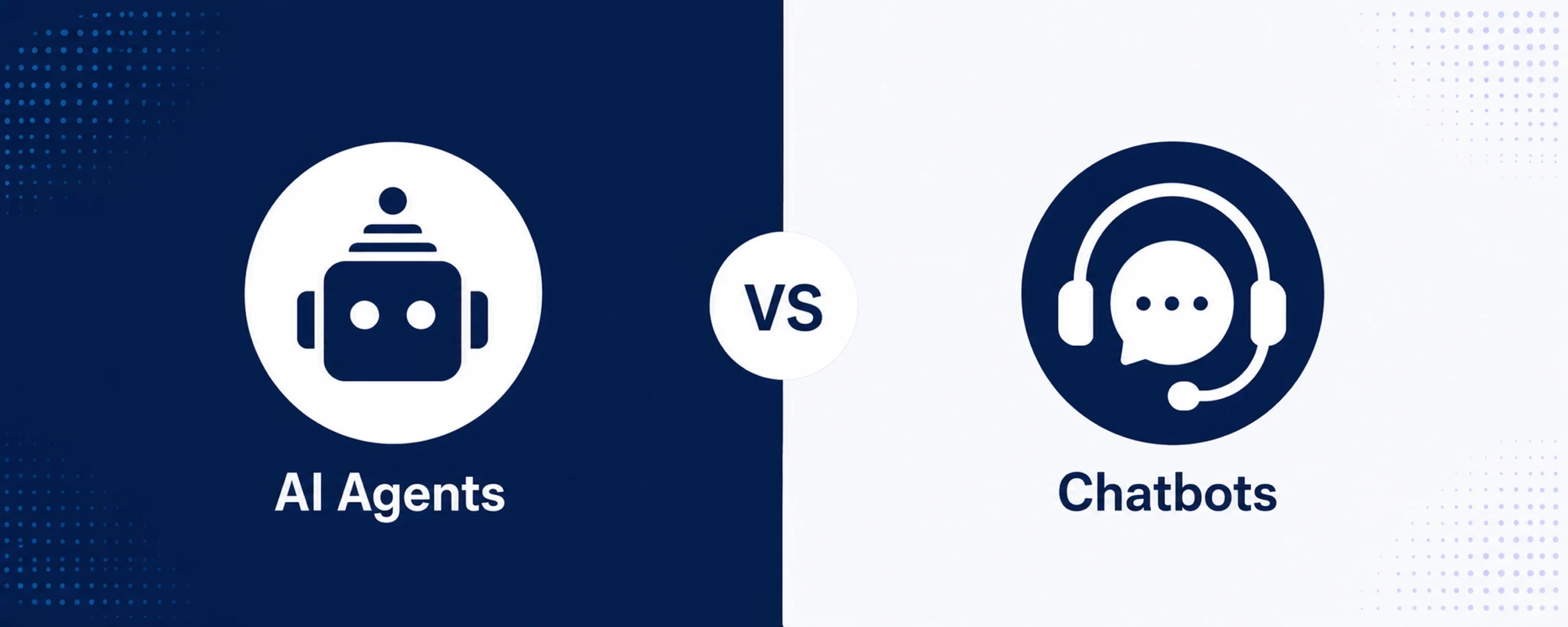
A chatbot is a conversation interface. An AI agent is an autonomous system that pursues a goal. Those are fundamentally different things – and once you understand the difference, it becomes clear why so many AI deployments underdeliver.
Businesses build chatbots when they need agents, then wonder why the AI is not doing anything useful beyond answering FAQ-style questions.
This article explains what is the difference between AI agent and chatbot, maps each to the right use cases, and describes what a production-grade AI agent deployment actually looks like.
What a Chatbot Is
A chatbot is a software system designed to simulate conversation. It receives an input – a message, a question, a command – generates a response, and returns it. The conversation then waits for the next input.
Traditional chatbots operate on rules and decision trees. A customer types “track my order,” the chatbot matches that phrase to a predefined response or flow, and follows a scripted path to the answer. These systems are fast, predictable, and easy to build – but brittle. Anything outside the scripted paths fails.
Modern AI-powered chatbots use large language models (LLMs) to generate more natural, contextually aware responses. They can handle a much wider range of inputs, maintain context across a conversation, and produce outputs that sound genuinely helpful rather than scripted. GPT-powered chatbots, customer support bots, and website assistants fall into this category.
What even the most capable LLM-powered chatbot shares with its rule-based predecessor is the fundamental interaction model: input in, response out. The chatbot does not take actions in the world. It does not call an API unless a human has explicitly integrated that function. It does not plan a sequence of steps to accomplish a goal. It responds.
What an AI Agent Is
An AI agent is a system that takes goal-directed action in the world. It receives an objective – qualify this lead, resolve this support ticket, find candidates matching these criteria – and autonomously determines what steps to take, executes those steps using available tools, evaluates the results, and continues until the goal is achieved or it escalates to a human.
The defining properties of an AI agent are:
- Goal orientation – The agent works toward an objective, not just a response. “Schedule a follow-up with this lead after three days if no reply” is a goal. “Here is the email draft for your follow-up” is a response.
- Tool use – Agents can call APIs, query databases, send emails, update CRM records, search the web, trigger workflows, and interact with external systems. A chatbot can tell you what your order status is if you ask. An agent can check your order status, identify a delay, notify the logistics team, and send you a proactive update without you asking anything.
- Autonomous sequencing – Agents decide what to do next. A chatbot waits for the next input. An agent evaluates its current state, determines the next action required to progress toward the goal, executes it, and continues.
- Memory and context across sessions – Production AI agents maintain memory across interactions, building a persistent understanding of the customer, the project, or the workflow they are managing. Chatbots typically operate within a single session window.
- Error handling and adaptation – When an action fails or returns unexpected results, an agent adapts its approach. A chatbot either fails gracefully or produces a generic error response.
The Practical Difference: A Side-by-Side Example
The clearest way to understand the difference is through a concrete business scenario.
Scenario: A sales team wants to handle inbound leads from a website form.
A chatbot approach handles this by placing a chat widget on the website that greets visitors, answers questions about the product, and collects contact details if the visitor expresses interest. A human sales rep then reviews the collected leads, does research, and sends a personalized follow-up. The chatbot handles the conversation layer. Everything else is still manual.
An AI agent approach handles the entire workflow. When a form is submitted:
- A research agent pulls LinkedIn and company data on the lead automatically
- A qualification agent scores the lead against defined ICP criteria
- A personalization agent drafts a customized outreach email based on the research
- An outreach agent sends the email and logs the activity in the CRM
- A follow-up agent monitors for a reply and triggers the next step based on response content
No human involvement until a qualified, engaged prospect is ready for a sales conversation. The agent handles discovery through to warm handoff.
Isometrik AI’s AI SDR and Prospect Search agents operate exactly this way – as a coordinated multi-agent outbound system, not a conversation interface. The business outcome is measurably different from a chatbot deployment.
Where Each Technology Belongs
Understanding the distinction helps businesses match the right technology to the right problem.
Chatbots are the right tool when:
- The use case is primarily conversational – answering questions, providing information, handling enquiries
- The interaction is largely stateless – each conversation is self-contained and does not require action in external systems
- The required responses can be reasonably anticipated and the quality bar is consistency rather than autonomy
- Examples: website FAQ assistant, basic customer support deflection, internal knowledge base search, product recommendation within a defined catalog
AI agents are the right tool when:
- The use case involves completing a multi-step task, not just answering a question
- The workflow requires interaction with external systems – CRMs, databases, APIs, communication platforms
- Autonomous decision-making within defined parameters would meaningfully improve speed, volume, or consistency
- Examples: lead qualification and outreach, support ticket resolution end to end, recruitment sourcing through to shortlisting, appointment scheduling with follow-up, order management with proactive updates
Multi-agent systems are the right tool when:
- The workflow spans multiple distinct domains (research, communication, data management, scheduling) that each benefit from specialization
- Volume is high enough that sequential single-agent processing creates bottlenecks
- Examples: entire sales prospecting pipelines, full-cycle recruitment automation, complex customer success workflows, multi-step onboarding processes
The majority of meaningful business AI deployments in 2026 require agents, not chatbots. Businesses that have deployed chatbots and found the results underwhelming are usually dealing with a scope mismatch rather than a technology failure.
Why the Distinction Matters for Buying Decisions
The chatbot vs. AI agent distinction has direct implications for how businesses should evaluate AI vendors and products.
Integration depth reveals the difference. A chatbot vendor will ask about your conversation flows and knowledge base. An AI agent vendor will ask about your CRM, your outbound tooling, your data sources, and what systems agents need to read from and write to. If an AI vendor is not asking about your tech stack, they are probably selling you a chatbot.
Measured outcomes tell you which one delivered. Chatbot success metrics are conversational – containment rate, deflection rate, CSAT scores. Agent success metrics are operational – leads qualified per day, support tickets auto-resolved, time-to-hire reduction, revenue generated. If the vendor is measuring conversation quality rather than business outcomes, the product is a chatbot regardless of what it is called.
Latency and reliability requirements differ. A chatbot that takes three seconds to respond in a chat window is acceptable. An AI agent managing a live customer call or a real-time order exception needs sub-second decision cycles. The underlying infrastructure requirements are different, and a chatbot-oriented platform will not meet agent-grade reliability requirements at scale.
How Isometrik AI Approaches This
Isometrik AI builds AI agents and multi-agent systems – not chatbots. The product portfolio reflects this distinction directly:
- AI SDR – An outbound sales agent that handles prospect research, personalized outreach, and follow-up sequences. This is a workflow automation product, not a conversation interface.
- AI Prospect Search – An agent that identifies and qualifies prospects against defined ICP criteria, pulling from multiple data sources and passing structured lead data to downstream agents or sales teams.
- Conversational AI – Voice AI infrastructure for inbound and outbound call handling at scale. This sits at the boundary between chatbot (conversation) and agent (goal-directed call completion with CRM integration), and is designed for production call volumes.
- Agent Studio – A visual multi-agent builder with 100+ templates, drag-and-drop workflow design, and full API integration. This is the orchestration layer that coordinates multiple agents across complex workflows without requiring code.
- AI Marketing – A multi-agent marketing workflow that handles content generation, distribution, and performance monitoring. One client using this system generated 2x more content and a 38% increase in monthly client inquiries.
The deployment model reinforces the operational framing. Isometrik’s three tiers – AI Strategy Session ($1K-$5K, 2-4 weeks), Pre-Built AI Teams ($5K-$25K, 4-6 weeks), and Custom Development ($5K-$300K, 12-16 weeks) – are scoped around workflow deployment and business outcome, not conversation design.
Production results from deployed systems demonstrate the agent-vs-chatbot difference clearly:
- XQtiv: 10x recruiter capacity increase through AI-driven hiring workflow automation
- zAIn: 80% improvement in service discovery efficiency through conversational AI with backend system integration
- Sensai: 300%+ increase in returning user rate through AI coaching workflows that replace static report delivery
None of these outcomes are achievable with a chatbot. All of them required agents that planned, acted, integrated with external systems, and measured outcomes.
Choosing the Right Starting Point
For businesses evaluating whether they need a chatbot or an AI agent, the answer usually comes from one question: does the outcome require taking action in a system, or does it only require generating a response?
If the answer is action – booking something, updating a record, sending a message, qualifying a lead, triggering a process – you need an agent. If the answer is response – answering a question, providing information, supporting a conversation – a chatbot may be sufficient.
Most businesses find, when they map their highest-value workflows, that the ones with the biggest ROI potential require agents. Automating a conversation deflects some support volume. Automating a workflow eliminates an entire operational cost center.
Isometrik AI’s free strategy session is designed for exactly this mapping exercise – identifying which workflows in your business would benefit most from agent deployment, what integration those agents would require, and what a realistic deployment timeline and ROI projection looks like.
The Bottom Line
The difference between an AI agent and a chatbot is the difference between a tool that responds and a system that acts. Chatbots handle conversation. AI agents handle workflows – autonomously, at scale, integrated with the systems your business already runs on.
Most businesses that are disappointed with their AI results deployed a chatbot where they needed an agent. The fix is not a better chatbot. It is the right architecture for the problem.
Isometrik AI builds production-grade AI agent systems across sales, support, operations, and vertical-specific workflows – deployable in 4-16 weeks depending on scope.
Book a free strategy call with Isometrik AI to identify the highest-value agent deployment opportunity in your business.