AI Agent with code execution: How It Works and Why Security Comes First

More AI tools now claim to “do the work,” not just answer questions. The real shift behind that claim is an AI Agent with code execution. It’s a system that writes a script, runs it, reads the result, and fixes its own mistakes. That loop is what turns a chatbot into a worker, and it’s spreading fast across business software.
Think legal teams drafting contracts, ecommerce brands crunching sales data, or banks running compliance checks. This capability changes what’s possible for each of them, often without anyone on the team calling it “code execution.” It also changes what can go wrong if nobody plans for it. Here’s how it works, where it fits your business, and what to check before you deploy one.
What Is an AI Agent with code execution?
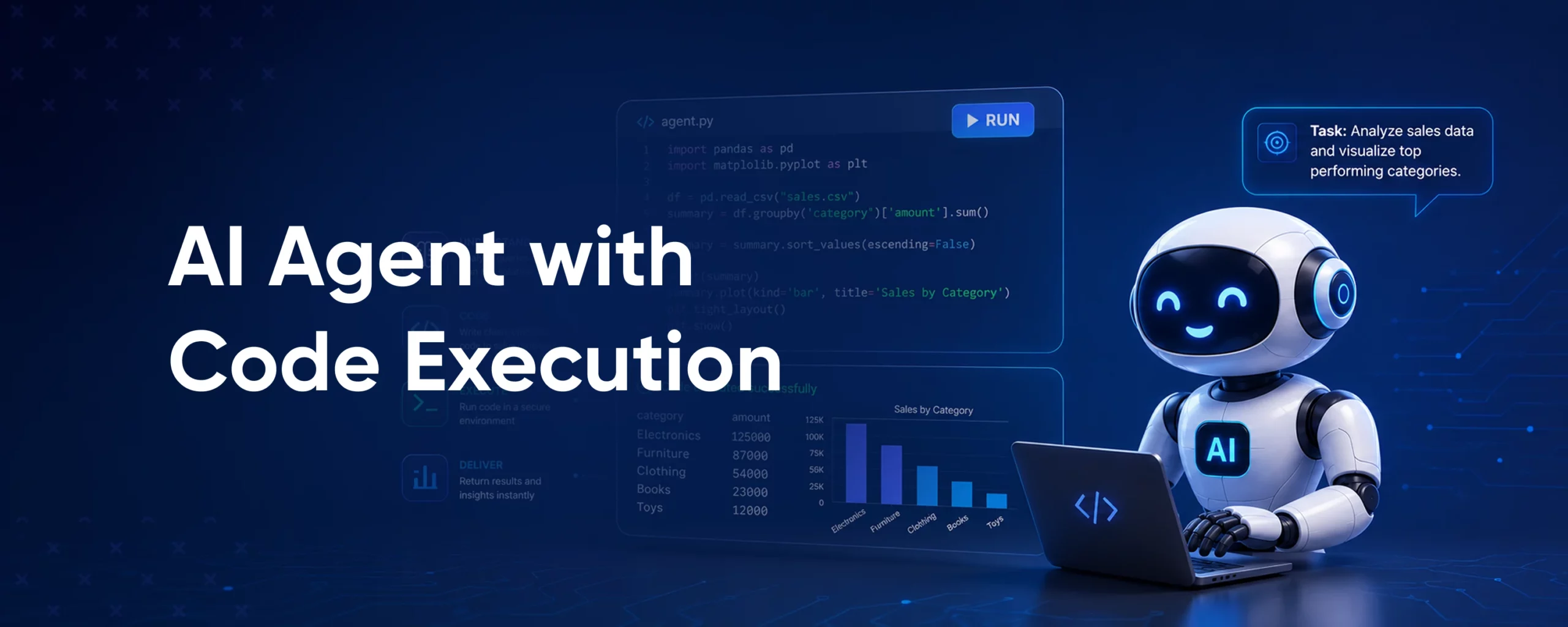
A standard chatbot only produces text. You read its answer, then decide what to do with it. An AI Agent with code execution skips that hand-off entirely. It writes actual code, runs it in a live environment, and acts on the result.
This is the real difference between agentic AI and a standard LLM: one responds, the other acts. Say you ask an agent to “find last quarter’s top customer segments.” A chatbot describes how you might do that. A code-executing agent writes a query, runs it against your data, checks the output, and returns an answer. Isometrik’s guide on agentic AI vs LLM breaks down that distinction in more depth.
That gap matters for everyday business tasks, not just engineering ones:
• Pulling and reformatting data from a CRM or spreadsheet
• Generating a chart or report from raw numbers on demand
• Testing a piece of logic before it ships to customers
• Cleaning up messy files without a human doing it by hand
• Checking its own output against a rule set before acting
Each of these once needed a developer at the keyboard. An agent can now attempt them directly, then report back with the result. That doesn’t remove the human from the loop. It moves the human from doing the task to reviewing it, which is a very different job.
For a support team, this might mean reconciling ticket data against billing records without opening a spreadsheet by hand. For a marketing team, it might mean generating a chart straight from an ad platform export. Neither needs a developer standing by to make it happen.
The Execution Loop: How These Agents Actually Work
Every code-executing agent follows a version of the same loop, regardless of vendor or framework. Blaxel’s engineering team draws a useful line here: code generation and code execution carry different risk profiles. One is a proposal. The other is a real action with consequences, and that difference is the whole point.
The loop breaks down into four steps:
• Plan: the agent breaks a goal into steps and flags what needs code
• Generate: it writes the code required for that step
• Execute: the code runs in an isolated environment, not your live systems
• Observe and retry: it reads the output or error, then corrects and reruns
This is what separates an agent from a simple assistant. An assistant hands you a draft and waits for direction. An agent tests its own draft first, then only surfaces the result once it has one worth showing you. That’s genuinely useful for repeatable, well-defined work.
It’s also exactly why the execution environment matters so much. A mistake inside that loop needs somewhere safe to land, not a live production system. The next section covers what that safe environment should look like. The details matter more than most buyers tend to assume.
Under the Hood: Sandboxes, Isolation, and Why It’s Not Optional
Here is the part every business buyer needs to understand, even without a technical background. The code your agent writes has not been reviewed by your team. It could be wrong, inefficient, or manipulated through a prompt injection attack.
LangChain’s engineering team makes the risk concrete: agents run untrusted code by definition. A 2025 npm supply-chain attack backdoored hundreds of packages before anyone could review them. An agent installing packages on your behalf carries that same exposure.
This is why serious platforms never let agent-generated code touch production systems directly. They run it inside a sandbox instead. A sandbox is a contained, disposable environment with no path back to your real data or infrastructure. If the code fails or misbehaves, the damage stays boxed in.
Not every sandbox offers equal protection. The isolation technology underneath decides how much a mistake, or an attack, can actually reach:
| Isolation type | How it works | Business risk if skipped |
| Standard container | Shares the host’s operating system kernel | A kernel exploit can escape the container entirely |
| gVisor sandbox | Intercepts system calls in a separate, memory-safe layer | Lower risk; some trade-off on I/O-heavy tasks |
| MicroVM | Runs a separate kernel per session, hardware-isolated | Strongest containment; the standard for untrusted code |
Two real deployments show this in practice. BentoRun, an open-source project built on Google Cloud Run, uses gVisor so agent-written Python never touches the host machine. AWS takes a related approach with Lambda, pairing isolated MicroVMs with a policy layer. That layer can block an agent from deploying to production without approval.
Neither company treats isolation as optional, and neither should your vendor. Ask what technology sits under the hood before you sign anything. A vague answer to that question is itself a warning sign worth taking seriously.
Isolation alone isn’t the whole story either. Enterprise buyers should also expect real observability: logs of what code ran, what it touched, and who reviewed it afterward. Without that trail, a compliance audit turns into guesswork.
Where This Shows Up Across Industries
This isn’t a developer-only capability anymore. Once an agent can safely write and run code, it opens up tasks that once required a technical hire. That holds true across nearly every sector Isometrik serves, often in ways teams don’t expect at first.
| Industry | What code execution enables |
| Legal | Drafting and cross-checking contract clauses against a rule set |
| Ecommerce | Reformatting product feeds and generating sales reports on demand |
| SaaS | Testing integration logic before a feature reaches customers |
| Logistics | Recalculating routes and costs when input data changes |
| Recruitment | Scoring and ranking resumes against structured criteria |
| Healthcare | Structuring intake data without touching protected records directly |
| Banking | Running reconciliation checks across transaction files |
Notice the pattern. In every row, the agent handles a well-defined, repeatable task, and a person still reviews the outcome before it counts. That combination is what makes this practical for a business team today, not a future one.
Nothing in that table requires your staff to learn to code. None of it removes the reviewer from the process, either. Most of these use cases start small: one agent, one repeatable step, inside a workflow your team already runs.
What to Look for in a Code-Execution-Ready AI Agent Platform
If you’re evaluating vendors, code execution shouldn’t be a checkbox feature. It’s an architecture decision that touches security, compliance, and cost all at once. That combination deserves real scrutiny before you commit budget. Use these five questions as a starting filter:
| Question to ask | Why it matters |
| Where does the code actually run? | Sandboxed execution keeps mistakes off your live systems |
| Who can review the execution logs? | Audit trails matter for compliance, not just debugging |
| Can you restrict what the agent touches? | Limits blast radius if something goes wrong |
| Does the platform hold relevant certifications? | SOC2, HIPAA, or GDPR proof, not just a claim |
| What’s the fallback if code fails mid-task? | Determines whether a failure is a hiccup or an outage |
A genuine enterprise AI agent platform will answer all five clearly, not just the first one. If your business runs on regulated infrastructure, a self-hosted AI agent platform is also worth a look. It keeps execution inside your own environment instead of a vendor’s shared cloud, which some compliance teams require outright.
None of these questions need a technical translator. A vendor confident in their architecture will walk you through the answers directly.
How Isometrik AI Builds This In
Isometrik’s Agent Studio treats safe code execution as a foundation, not an add-on. Every agent your team builds runs through a sandbox testing environment before it ever reaches production. Nothing goes live on a guess, and nothing skips that step to save time.
That foundation includes a few specific safeguards:
• Sandbox testing environments for every agent before deployment
• Custom tool development for workflows unique to your business
• Role-based access control paired with complete audit trails
• Compliance built in as standard, detailed in our guide to a SOC2 compliant AI agent platform
This matters most for regulated sectors. A healthcare team building an intake agent needs proof of containment. So does a bank automating reconciliation. Neither can settle for a vendor’s promise alone.
Isometrik’s AI Agent Builder pairs a no-code interface with this enterprise-grade backend. Your team gets the speed of a visual builder. It never has to trade away the isolation a code-executing agent requires to run safely.
Getting Started: A Rollout Checklist for Non-Technical Teams
You don’t need an engineering department to adopt an AI Agent with code execution responsibly. Most of the real risk sits in process, not in the technology alone. You need a short, disciplined rollout plan instead, built around a few clear checkpoints:
1. Start with one well-defined, repeatable task, not a full department
2. Ask your vendor exactly where the agent’s code will run
3. Keep a human reviewing outputs until the agent earns trust
4. Confirm audit logs exist before you scale to a second use case
5. Revisit this checklist every time you add a new integration
Treat each checkpoint as a gate, not a formality. A team that skips straight to scale usually finds the gaps the hard way. That often happens after something has already gone wrong in production.
Code execution is what turns an AI agent from a chatbot into something that gets real work done. With the right sandboxing, an AI Agent with code execution is one of the safer ways to automate a task. Left unmanaged, it becomes a real liability instead. The vendor you choose decides which side of that line your business lands on.